CPD “Approach to paediatric malnutrition” 3pm 4 Nov

See Dr. Tim De Maayer, Paediatric Gastroenterologist, University of Witwatersrand/Rahima Moosa Mother and Child Hospital, Jhb, SA, talk about the “”Approach to paediatric malnutrition”” at 3 pm on Thursday 4th November 2021 in the CPD webinar of the African Forum for Primary Health Care (AfroPHC). This will be accredited for CPD for South Africa for now but we are busy arranging it via World Continuing Education Alliance for these meetings to be accredited for CPD in many African countries.

Register in advance for this webinar. After registering, you will receive a confirmation email containing information about joining the webinar. The presentation and recording will be below.

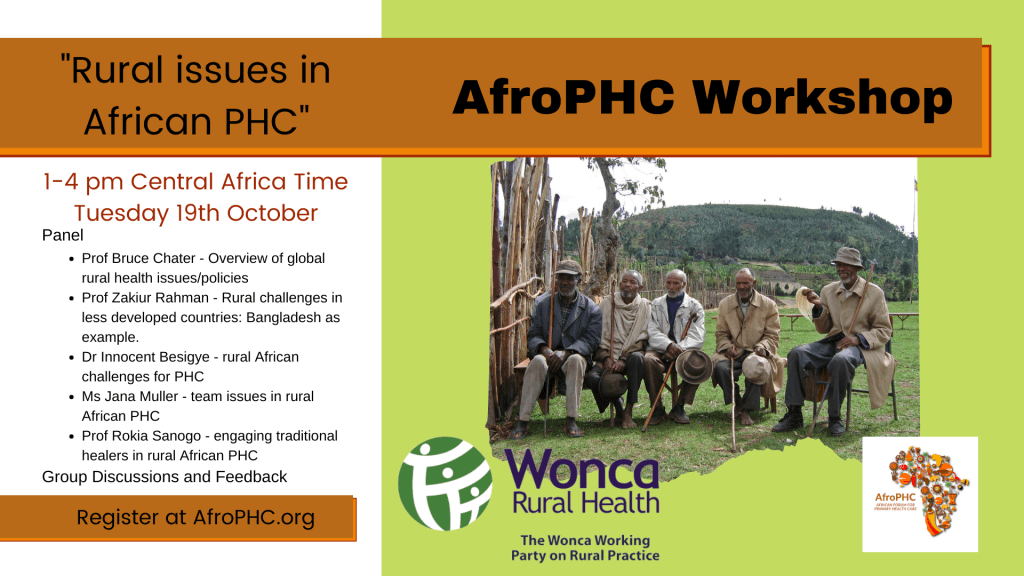
AfroPHC Workshop 19th Oct “Rural issues in African PHC”

We are really pleased that AfroPHC to partner with the WONCA Working Party on Rural Practice “Rural WONCA” in their Ugandan-hosted Webinar Series. We invite you to a joint eWorkshop 1-4 pm Central Africa Time on Tuesday 19th October on “Exploring Rural Issues in African PHC”. Check for your local time here.

AfroPHC leaders will introduce the session and panellists.

  • Prof Bruce Chater – Overview of global rural health issues/policies
  • Prof Zakiur Rahman – Rural challenges in less developed countries: Bangladesh as example.
  • Dr Innocent Besigye – rural African challenges for PHC
  • Ms Jana Muller – team issues in rural African PHC
  • Prof Rokia Sanogo – engaging traditional healers in rural African PHC

We will then break up into small groups for 45 minutes to discuss the question “How do we improve rural African PHC?” We will close the meeting with feedback and summarising key issues. See profiles of speakers below. Look at the Blueprint for Rural Health . Register below. We will send link before meeting.

Bruce Chater is family physician and the Chair of the Wonca Working Party on Rural Practice. He is also a professor in the Mayne Academy of Rural and Remote Medicine, University of Queensland, Immediate Past Chair, Statewide Rural and Remote Clinical Network, Department of Health, Queensland and Medical Superintendent with Right to Private Practice, Theodore and Medical Director, Banana Health Service, Central Queensland Hospital and Health Service 

Zakiur Rahman is a family physician in Dhaka, Bangladesh. He is an associate professor of Family Medicine linked to the Bangladesh College of General Practitioners. He is a five star doctor awardee in Wonca South Asia 2021. He is currently working in rural center more the 100 km far from capital Dhaka. He is the President of Primary Care & Rural Health Bangladesh since 2015. He is a member of Rural Wonca with the executive portfolio of research since 2016.

Innocent Besigye is a family physician in Uganda, the chair of the Ugandan Family Physicians Association and President of AfroPHC. He also serves on the executive committee of Primafamed, the family medicine training network in Africa and is linked to the Besrour Forum. He is co-editor of the African Journal of Family Medicine and Primary Health Care

Jana Müller is an academic coordinator at Ukwanda CRH, Stellenbosch University, South Africa with a focus on interprofessional education and collaborative care. She has been involved with students facilitation and community engagement in rural communities since 2011 and assisted with the expansion of clinical training to Upington in the Northern Cape, South Africa. A physiotherapist by profession, she has a special interest in rural health professions education and interprofessional primary health care.

Rokia Sanogo is s pharmacologist with a PhD working in Titulaire des Universités – Chef de DER des Sciences Pharmaceutiques, Faculté de Pharmacie – USTTB – Chef de Département Médecine Traditionnelle – Institut National de Recherche en Santé Publique B.P. 1746 in Bamako, Mali.

AfroPHC Advisory Board

AfroPHC is an organisation of leaders of PHC healthcare workers across Africa. It has strong diversity of members and elected board members, all keen to advocate for appropriate PHC and Universal Health Coverage (UHC). AfroPHC has a strong vision, mission and strategic objectives for African primary care service delivery.

A key part of the strategy is build alliances and networks. we have reached out to a number of organisations that are pan-African or global in nature and very important to our mission to support AfroPHC. See list of Supporting Organisations. We set up an Advisory Board (up to 30 members) to meet at least six monthly to review our work and build strong collaborations, mostly from AfroPHC Supporting Organisations. They are listed here

CPD “Approach to Arthritis” 3pm 14 Oct

See Dr. Sarah Swartbooi, Orthopaedic Surgeon, University of Witwatersrand/Chris Hani Baragwanath Academic Hospital, Jhb, SA, talk about the “Approach to arthritis” at 3 pm on Thursday 14th October 2021 in the CPD webinar of the African Forum for Primary Health Care (AfroPHC). This will be accredited for CPD for South Africa for now but we are busy arranging it via World Continuing Education Alliance for these meetings to be accredited for CPD in many African countries.

The presentation and recording will be below.

CPD “Latest on PMTCT, PEP, PrEP and AYFS” 3pm 7 Oct

See Dr. Melanie Collins, Technical Advisor: Paediatrics and Adolescents, Anova Health Institute, Jhb, SA, talk about the “Latest on Prevention of Mother to Child Transmission, Post-Exposure Prophylaxis, Pre-Exposure Prophylaxis and Adolescent Youth Friendly Services” at 3 pm on Thursday 7th October 2021 in the CPD webinar of the African Forum for Primary Health Care (AfroPHC). This will be accredited for CPD for South Africa for now but we are busy arranging it via World Continuing Education Alliance for these meetings to be accredited for CPD in many African countries.

Register in advance for this meeting. After registering, you will receive a confirmation email containing information about joining the webinar. The presentation and recording will be below afterwards.

AfroPHC CPD “ECGs in PHC” 3pm 9 Sep

See Dr. Shane Murphy, Family Medicine Registrar, Department of Family Medicine, Johannesburg Health District, talk about the “”Easily interpreting ECGs in PHC”” at 3 pm on Thursday 9th September 2021 in the CPD webinar of the African Forum for Primary Health Care (AfroPHC). This will be accredited for CPD for South Africa for now but we are busy arranging it via World Continuing Education Alliance for these meetings to be accredited for CPD in many African countries.

Dr. Shane Murphy, Family Medicine Registrar, Year 4. MBChB (UP), Dip HIV Man (SA), Dip PEC (SA), H Dip EM (SA), MPH (UoR). Shane has a strong interest in Emergency Medicine and is an instructor on ATLS, APLS and emergency sonar courses. He is also involved in content coordination and website development for the Rural Life Support Course. He is currently completing a Digital Scholar Fellowship with CanadiEM and using this platform to develop local content for FOAMed (Free Open Access Medical Education) in South Africa.

He believes that ECG’s are an underutilised standard of care in South African primary care settings and hopes to develop competence and confidence amongst practitioners to interpret these studies.

Register in advance for this meeting. After registering, you will receive a confirmation email containing information about joining the webinar. The presentation and recording will be below afterwards.

Here is a link to the slides – additional examples are present. The diagnosis of the ECGs are in the notes section under each slide.

https://docs.google.com/presentation/d/1WgmA0s47qR19gNplLvRF2CKTPlu66PgY/edit?usp=sharing&ouid=108072809223214228792&rtpof=true&sd=true

Useful resources:

AfroPHC CPD “Seizures in children” 3pm 2 Sep

See Prof Ashraf Coovadia, Academic Head of Paediatrics, University of Witwatersrand / Rahima Moosa Hospital, Jhb, SA talk about the “Seizures and Status Epilepticus in childrem” at 3 pm on Thursday 2nd September 2021 in the CPD webinar of the African Forum for Primary Health Care (AfroPHC). This will be accredited for CPD for South Africa for now but we are busy arranging it via World Continuing Education Alliance for these meetings to be accredited for CPD in many African countries.

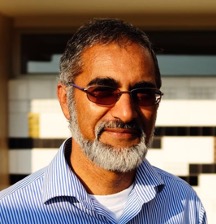
Adjunct Professor Ashraf Hassen Coovadia (MBChB, DCH (CMSA), Dip HIV Man (CMSA) FCP (Paed CMSA) is Academic Head of Department , Dept of Paediatrics and Child Health, University of the Witwatersrand since (October 2016) and Head of Department of Paediatrics at the Rahima Moosa Mother and Child Hospital, Johannesburg (since January 2014).

He completed his undergraduate training at the University of Zambia in 1990 and his paediatric postgraduate training at the University of the Witwatersrand in 1998. Since 1998 has championed the cause of Paediatric HIV/AIDS and Prevention of Mother to Child Transmission of HIV (PMTCT). He was on SANAC (South African National AIDS Council), the Resuscitation Council of Southern Africa and the Paediatric Task Force of the International Liaison Committee on Resuscitation (ILCOR) 2001 -2010. His current area of interest: medical education, paediatric emergency medicine training, clinical trials involving HIV-infected pregnant women and children,

Register in advance for this meeting. After registering, you will receive a confirmation email containing information about joining the webinar. The presentation and recording will be below afterwards.

This meeting is different in that you are expected to listen to these two short videos/podcasts below and then interact with the polls and with Q&A.

https://www.stitcher.com/show/pedscasescom-pediatrics-for-medical-students/episode/status-epilepticus-in-children-53791129

https://www.stitcher.com/show/pediacast-cme/episode/seizures-epilepsy-pediacast-cme-048-63527973

Do the quizz afterwards here https://www.surveymonkey.com/r/SeizureQuiz

PAWPER TAPE https://mdinc.co.za/store/products/equipment/pawper-tape-flipper-card/

Pedi STAT https://apps.apple.com/us/app/pedi-stat/id327963391

AfrIPEN Conference 2021

Join the 3rd Africa Interprofessional Education Network (AfrIPEN) virtual conference 13h00-18h00 Central African Time on 15-17th September 2021. See the programme and registration details in the documents below. You can also register here.

AfroPHC CPD “Iron Deficiency Anaemia” 3pm 26 Aug

See Dr Garrick Laudin, Haematologist in Chris Hani Baragwanath Academic Hospital and Wits University, Jhb, SA, talk about the “Iron and Iron Deficiency Anaemias” at 3 pm on Thursday 26th August 2021 in the CPD webinar of the African Forum for Primary Health Care (AfroPHC). This will be accredited for CPD for South Africa for now but we are busy arranging it via World Continuing Education Alliance for these meetings to be accredited for CPD in many African countries.

Dr Garrick Laudin completed his undergraduate medical education at the University of Witwatersrand and qualified as a specialist physician after completing registrar training and his Mmed (Int Med) at the University of Pretoria.

He is currently a fellow in Clinical Haematology at Chris Hani Baragwanath Academic Hospital in Johannesburg.

Register in advance for this webinar. After registering, you will receive a confirmation email containing information about joining the webinar. The presentation and recording will be below afterwards.

AfroPHC CPD “Mgmt of woman with LAP” 3pm 19 Aug

See Dr. Coceka Mnyani, Gynaecologist in the District Clinical Specialist Team, Jhb, SA, talk about the “Management of the woman of childbearing age presenting with LAP” at 3 pm on Thursday 19th August 2021 in the CPD webinar of the African Forum for Primary Health Care (AfroPHC). This will be accredited for CPD for South Africa for now but we are busy arranging it via World Continuing Education Alliance for these meetings to be accredited for CPD in many African countries.

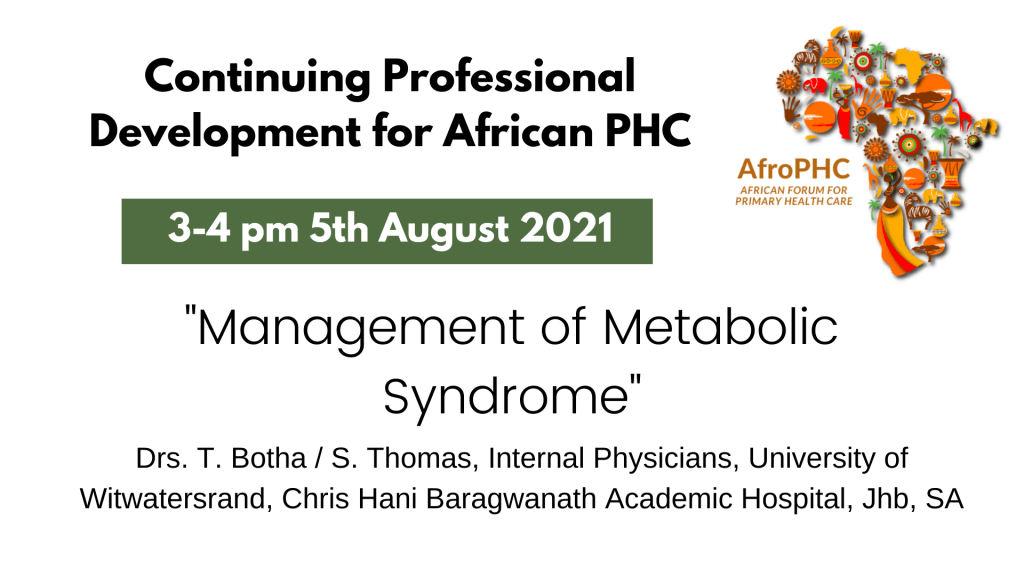
AfroPHC CPD “Mgmt of Metabolic Syndrome” 3 pm 5 Aug

See Dr’s Theunis Botha and Sumi Thomas, Internal Physicians in the University of Witwatersrand and Chris Hani Baragwanath Academic Hospital, Jhb, SA, talk about the “Management of Metabolic Syndrome” at 3 pm on Thursday 5th July 2021 in the CPD webinar of the African Forum for Primary Health Care (AfroPHC). This will be accredited for CPD for South Africa for now but we are busy arranging it via World Continuing Education Alliance for these meetings to be accredited for CPD in many African countries.

The recording and slides are below. See programme for 2021 here.

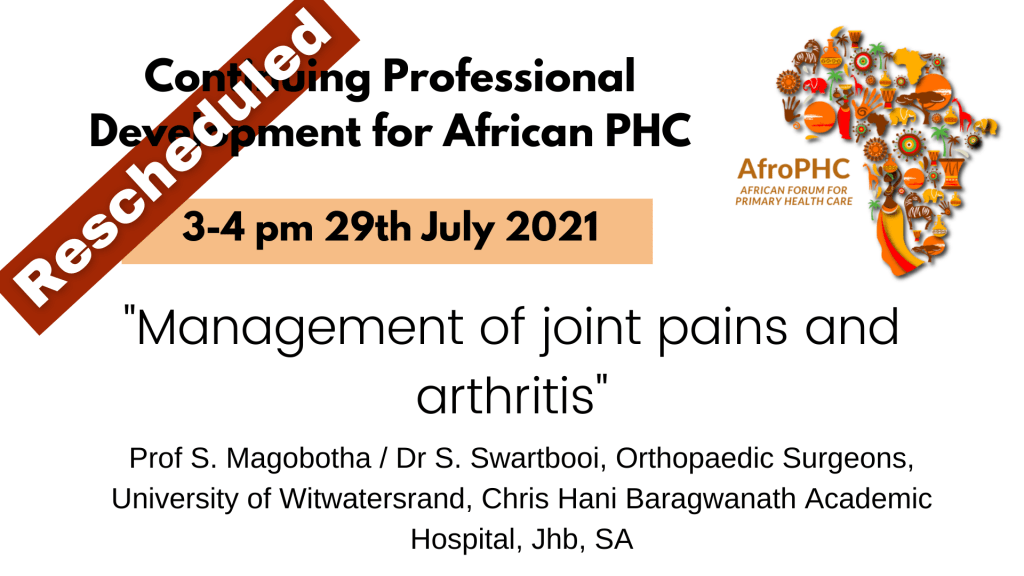
AfroPHC CPD “Mgmt of joint pains” 3 pm 29 July

See Dr Sara Swartbooi and Prof Sebastian Magobotha, Orthopaedic Surgeons in the University of Witwatersrand and Chris Hani Baragwanath Academic Hospital, Jhb, SA, talk about the “Management of joint pains and arthritis” at 3 pm on Thursday 29th July 2021 in the CPD webinar of the African Forum for Primary Health Care (AfroPHC). This will be accredited for CPD for South Africa for now but we are busy arranging it via World Continuing Education Alliance for it to be accredited for CPD in many African countries.

The recording and slides are below. See programme for 2021 here

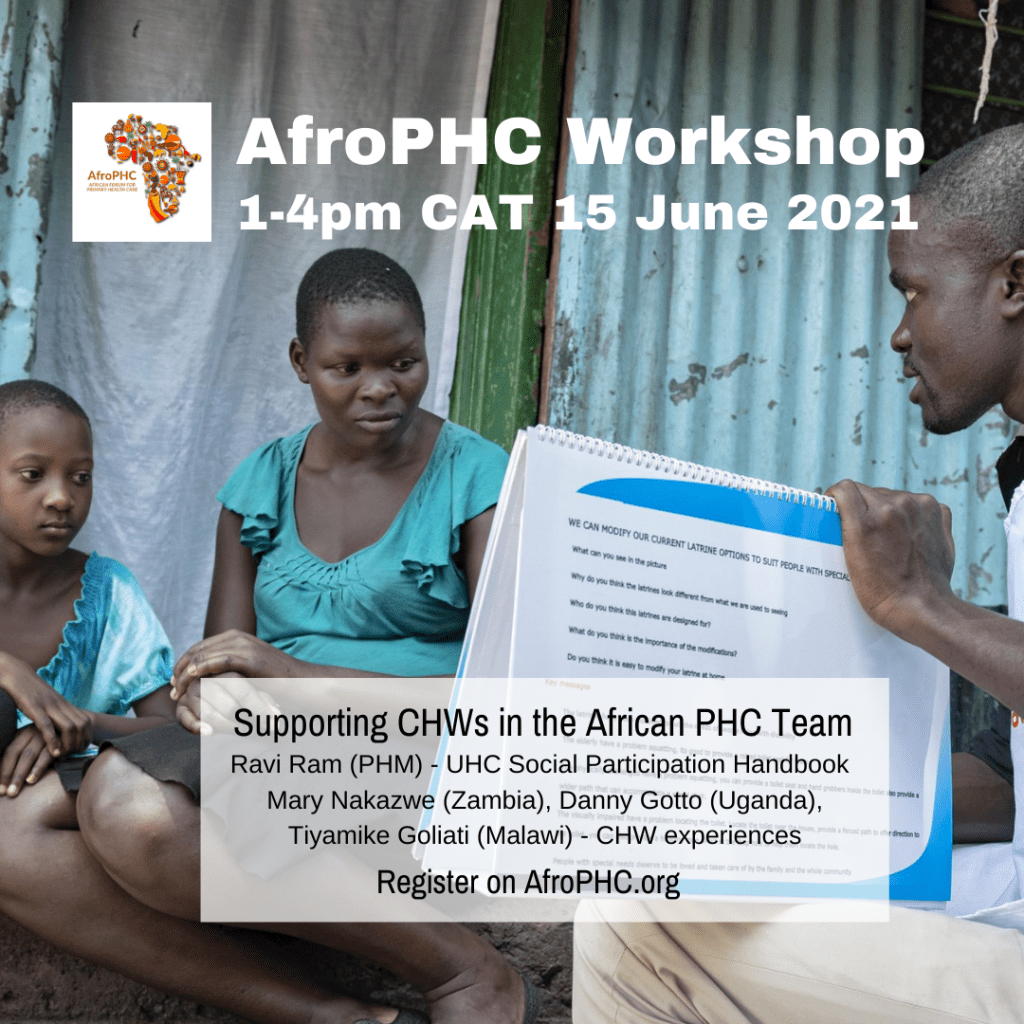
AfroPHC Workshop 15th June 2021 on CHWs

Join the AfroPHC Policy Workshop 1-4pm CAT on Tuesday 15th June 2021 on “Supporting Community Health Workers in the African PHC Team”. This will be in the format of a moderated discussion with panellists for 90min and then group discussion (60min) and feedback (30min). See details and register here.

AfroPHC Executive Board meets

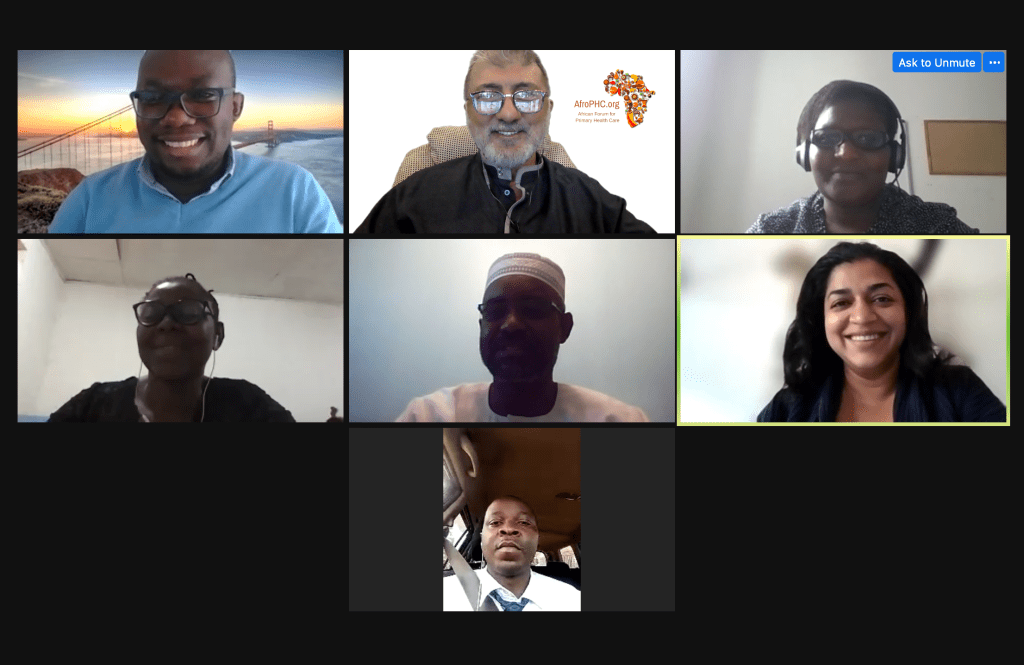
The new AfroPHC Executive Board (EB) met on 7th May 2021 for the first time under the chairmanship of Dr Champion Nyoni and appointed Prof. Shabir Moosa as the first Executive Coordinator. The EB elected Dr Innocent Besigye of Uganda as President and Ms Francoise Nwabufo of Cameroon as Vice-President of the Board. The EB also filled the space vacated by Prof Moosa and the two co-options by adding Dr Marie Claire Wangari, Dr. Lizemari Hugo and Ms, Tolulope. See pic below.

New AfroPHC Executive Board

A total of 210 AfroPHC members, with 164 attending on Zoom in a maximum concurrent attendance of 116, out of a registered total of 437 AfroPHC members on EngageBay voted the following nine-member AfroPHC Executive Board into place. This was after an extensive vetting of candidates at the Launch AGM.

Executive Board Members

  • Abdellah Almoghirah (46, Male, Community Medicine Specialist, Sudan)
  • Aja Godwin (57, Male, Professor/Chair of Public Health / TUFH Board, Nigeria – TUFH Rep)
  • Ana Joseph (65+, Male, Professor / Africa Centre for Clinical Governance Research & Patient Safety, Nigeria
  • Besigye Innocent (50+, Male, Family Physician, Uganda – Primafamed Rep)
  • Chaibva Cynthia (60+, Female, PhD Nurse-Midwife, Zimbabwe)
  • Karnad Radha (40+, Female, Senior Technical Advisor for Primary Health Care and Doctor, Kenya/ USA – Jhpiego Rep)
  • Moosa Shabir (58, Male, Prof/Wonca Africa President, South Africa – WONCA Africa Rep)
  • Nwabufo Francoise (40+, Female, Public health, President Family Health & Development Foundation, Cameroon)
  • Sibanda Bongi (41, Female, Advanced Nurse Practitioner, Zimbabwe/UK)

The new Executive Board is scheduled to meet 2-5pm on Friday 7th May to get a full briefing of AfroPHC activities and to take the organisation forward.

AfroPHC Launched

AfroPHC had its launch AGM on 20th April 2021 where Articles of Association was adopted (with amendments) and a new nine-member Executive Board was elected by over 200 of the 350+ formal members of the African Forum for Primary Health Care. There was a wide array of candidates from across Africa, all with great stories to tell and showing the wealth of leadership available to take forward the cause of PHC and UHC in Africa. See details of AGM here

Development of AfroPHC

As a result of the growing relationship between WONCA Africa and WHO AFRO Dr Prosper Tumusiime joined the WONCA Africa Conference of June 2019 in Kampala, Uganda. We had a workshop with Dr Tumusiime on building the collaboration between WONCA Africa and WHO AFRO. In exploring opportunities Professor Jan de Maeseneer suggested developing an African forum for primary care, along the lines of the European Forum for Primary Care (EFPC). The EFPC was set up in 2005 as a forum of primary care providers to promote strong primary care in Europe.

This idea was explored further in the second Interprofessional Education and Collaborative Conference for Africa of the Africa Interprofessional Education Network (AfrIPEN) held in Nairobi, Kenya in August 2019. AfrIPEN is a partnership between various institutions and individual seeking to establish interprofessional education and collaborative practice (IPE) as integral part in training the health workforce and in the effective functioning of systems for health in Sub-Saharan Africa. The meeting was opportune as AfrIPEN had a multitude of various health professionals in its midst and had established a relationship with WHO AFRO, with Dr Tumusiime being at the conference as well. The idea of AfroPHC was nurtured with various leaders engaged, especially Dr Tumusiime of WHO AFRO, Dr. Champion Nyoni of AfrIPEN and Ms. Bongi Sibanda, leading the African Advanced Practice Nursing initiative. There was great enthusiasm, some basic ideas and other African PHC groups / leaders identified.

A short document sharing the vision for AfroPHC and a planned face-to-face gathering in June 2020 was developed amongst identified leadership of African frontline primary health care worker organisations in the context of the high-level UHC Declaration in September 2019. The vision essentially was to advocate for appropriate PHC and UHC in Africa by bringing together the leadership of all healthcare workers at the coalface of African primary care and ensure that we had a voice in policy on primary care (PC) / primary health care (PHC) in Africa. The plan was to develop an African Forum for Primary Health Care (AfroPHC) as the voice of the PC/PHC team and its supporters, sharing and supporting each other in advocating for PHC. The strategy was to engage each other using a Google Group and plan a face-to-face workshop in June 2020. There was instant enthusiasm with a wide range of relevant organisations joining the call, including WONCA Africa (for family doctors), African Network of Associate Clinicians (for clinical officers/associates), AAAPN Coalition (for family nurse practitioners), ICN (for nurses generally), Towards Unity For Health (for public health practitioners), AFREHealth (for health educators / researchers in Africa), AfrIPEN (for allied health professions and interprofessional practice), Primafamed (for family medicine educators), AMREF (for CHWs/community stakeholders), West African Institute of Public Health and its Academy (for public health) and WHO AFRO. They formed the AfroPHC Core Team.

Whilst the planned face-to-face AfroPHC workshop in June 2020 did not materialise due to COVID-19 there were a number of achievements over 2020. These PHC organisations (and a number of global supporters e.g. PHCPI) met monthly online as the AfroPHC Core Team. There were a series of webinars from February to May 2020 allowing the different organisations to share more about themselves and their constituencies in Africa. AfroPHC was also part of a series of webinars on COVID 19 responses. A collaboration with AMREF resulted in the offering of the online Leadership, Management and Governance of Health Systems Strengthening Course to AfroPHC constituents, garnering more than 200 participants. More recently there is a collaboration with the World Continuing Education Council to provide continuing professional development courses to constituencies. Membership sits at over 600 in the AfroPHC Google Group, serving as a communication vehicle for African PHC stakeholders.

The AfroPHC core team gelled African teamwork amongst PHC team leaders but visible PHC teamwork across Africa started with the first AfroPHC workshop over 9-11 September 2020. Dr Tumusiime, of WHO AFRO, opened the workshop. Various PHC leaders then shared their thoughts over the three three-hour sessions on getting to know the PHC Team in Africa, what the community expects from PHC in Africa and how the PHC team should function in Africa. It was billed by participants as brilliant and one of its kind, especially for its online participation and interactivity.  The workshop emerged with an AfroPHC Statement that laid out key principles for the organisation. It stressed the nature of PHC as people-centred, with PHC human resources, capacity development, teamwork, inclusive PHC leadership and advocacy as key.

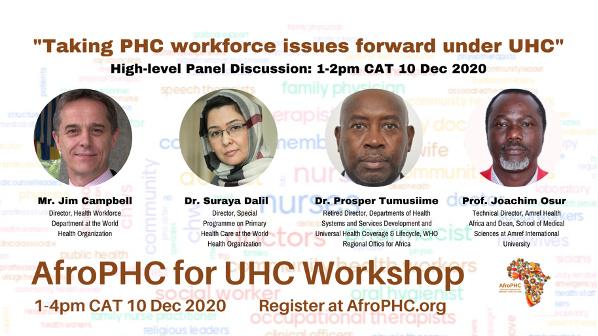
The resulting AfroPHC Statement was released at the AfroPHC for UHC Workshop on 10th December 2020. Mr. Jim Campbell (Director Workforce at WHO) and  Dr Suraya Dalil (Director PHC at WHO) were part of the panel in this workshop, reviewing the statement and reflecting on workforce issues for PHC in Africa. This workshop also considered the development of AfroPHC as a formal organisation. A report on the UHC Workshop and further plans including the launch of AfroPHC as a formal organisation will be released shortly.

What has become plain is that PHC teamwork is taking quick shape at a high level in Africa. The various deliberations have shown that we share more than we expected. It is very possible that we will be able to produce a document on PHC Teamwork in Africa that will be tabled with WHO AFRO and that will help define the development of PHC and UHC in Africa.

WONCA Africa provides considerable leadership and material support to the development of AfroPHC. It is warming to know that this leadership by WONCA Africa is respected by all the various leaders of the PHC team in Africa. WONCA Africa and Primafamed have even been drawn into development of the Advanced Practice Nurse Training Framework in Africa. The strong cohesion of AfroPHC is respected by many stakeholders, with AfroPHC (and WONCA Africa) being drawn into a number of pan-African and global forums as an organisation that stakeholders are eager to listen to.

AfroPHC speaks to the value that the best leaders are those who build the team around them as leaders: an attribute that family physicians across Africa need to nurture as a part of their daily PHC teamwork.

Associate Professor Shabir Moosa Wonca Africa President

Report on AfroPHC for UHC Workshop 10th December 2020

AfroPHC had a 3hr virtual workshop, linked to UHC Day, on 1-4 pm (Central African Time) 10th Dec 2020 to workshop the question “What is next for AfroPHC, considering the UHC movement?” We were especially concerned about workforce issues in PHC under UHC.

The workshop from 1-4 pm consisted of a plenary of 60 min, group discussions for 60 min and feedback in the next 60min on the following questions. We also wanted to explore how to set AfroPHC up as a formal organisation. See the draft AfroPHC founding document

We had 311 registrants and ±100 attendants during the 3 hr workshop. We had professions of nurse (incl. FNPs), medical doctor, public health, ambulance assistant, pharmacist, dentist, physiotherapists, medical sociologist, researchers, medical eye health attend from SA, Kenya, Uganda, Zimbabwe, Nigeria, Rwanda, Lesotho, Zimbabwe + USA, UK, Pakistan, Myanmar.

There were welcomes from global leaders:

  • Dr. Donald Li, World President of WONCA (World Organisation of Family Doctors) spoke of comprehensive person-centred PHC by qualified teams caring for designated populations for UHC. He was delighted by the AfroPHC work by frontline staff and urged them to show the way forward.
  • Ms. Thembeka Gwaga, Vice President of the International Council of Nursing (ICN) appreciated AfroPHC for its leadership. She wanted and was glad that nurses were included in the leadership e.g., Bongi Sibanda. PHC includes all practitioners and must be inclusive. WHO Report on Nursing – emphasise nursing education and workforce issues. Global shortage will worsen in Africa with migration- gear ourselves for that.
  • Dr. Mary Showstark, Communications Director of the International PA Educators Group (IPAG) and founder of of IFPACS for Students shared that the discipline of Physician Assistants were in 15 different countries under 14 different names across Africa. She said that PA’s were a valuable member of the PHC team and that they are looking at curriculum development and advocacy. PA’s are keen to work in interprofessional teams for patients and did not want to take other people’s jobs. She urged that different PHC disciplines cannot work in silos and wished AfroPHC well.

A key feature of the workshop was a plenary of four influential panellists who discussed how PHC activists should navigate the UHC movement and advance the vision of AfroPHC, moderated by Bongi Sibanda and Shabir Moosa

Key reflections on the AfroPHC Statement made by each of the four panellists were:

Mr. Jim Campbell: Director, Health Workforce Department at the World Health Organization welcomed the statement with the following reflections. He supported the leadership/advocacy role of AfroPHC especially as it was African (vs. regional) and inclusive of different PHC groups. He supported the language on multidisciplinary teams, as aligned to Astana/WHO language and stressed that all relevant health care workers be included especially representatives of labour to address decent work/pay issues. He shared that task-shifting was important (i.e. different occupations / scopes of practice takes on different roles) but that it was not the same as teamwork, where everyone is focused as a teamon holistic patient-centred care. On being asked whether doctors needed to be part of the PHC team he responded that the medical team was part of team to take all forward and that clinical supervision and leadership comes from specialists. He advised that we engage with healthcare worker management issues including the WHO policy on CHWs. He also advised education as lifelong learning vs training  as a once-off exercise. He urged AfroPHC to engage the private sector on mixed health systems and partnerships for public purpose with government stewardship.

Dr. Suraya Dalil: Director, Special Programme on Primary Health Care at the World Health Organization congratulated Afro PHC on the creation of the forum and the statement. She shared that the history of PHC, from Alma Ata in 1978 to the Astana Declaration in 2018 (within the SDG context) had people and equity at the core. She urged well-trained well-distributed, well cared for, empowered health care workers working from prevention to rehabilitation.  She said there was a need to create an enabling environment with supportive supervision, continued learning, safety at work, decent pay. She also said that gender and youth issues in human resource need to be addressed. She urged career development and progression, that we optimise quality and impact thro evidence-based policies. She urged investment in human resource and labour markets for PHC. She prioritised education with strong institutions. She felt that we need to strengthen data for human resources for PHC, noting that the healthcare workforce information system nomenclature is challenged and needs to be created. She hoped that WHO would help harmonise the different categories and disciplines in PHC. She urged that we include human resources in the private sector and to do workforce modelling, looking at gaps in delivery. She bemoaned the high unemployment of nurses. She urged that multidisciplinary teamwork in PHC goes beyond health of care, and that we liaise with networks and other disciplines e.g. education, environment, trade and community-based structures. We need to link individual care with population care (as seen needed in COVID). She urged the need to institutionalise the aligned policies at national level, including departments of finance, education and labour. She felt that we, as providers of care, are strategically located to develop trust between the state and the population. She informed the meeting of the WHA adopted the PHC Operational Framework with 14 levers (4 strategic and 10 operational lever). One of the operational levers is health workforce.

Prof. Joachim Osur: Technical Director, Amref Health Africa and Dean, School of Medical Sciences at Amref International University echoed AMREF’s support and community work. He suggested that we need actionable points and details e.g. what is team looking like and who is leading it? If we say health in all policies – is agriculture etc. also part of PHC? He urged that we engage with community systems in place (sociocultural/traditional) and don’t adopt a medical model of PHC service delivery and address financial resources for PHC: human resources, procurement etc. and raise the Abuja Declaration. He responded that healthcare workers need to be educated to manage resources. He also challenged matching the training to actual work tasks, not just diseases but psychosocial issues, thus needing comprehensive training with the multidisciplinary team based in workspace and involving others useful to intersectoral collaboration e.g. training institutions.

Dr. Prosper Tumusiime: Retired Director, Departments of Health Systems and Services Development and Universal Health Coverage & Lifecycle, WHO Regional Office for Africa appreciated the statement as it brings out principles. He stressed the need to outline aims/objectives of the forum in respect of healthcare workforce issues for UHC/PHC. He also urged that we address the multi-sectoral nature of PHC with SDGs and bring them in. He said that we need to use technology and digital health even in education. He said we needed sustainability of achievements with locally generated solutions. He urged AfroPHC to be clear and deliberate on PHC finances (both public and private) and to go beyond advocacy with actionable issues and evidenced needs in which we can track progress and find gaps in what we agreed. In response to questions on decentralised funding he share that in the past planning was done at ministry level with the periphery just receiving what was sent, not being part of planning. He urged that it was important to identify real requirements at grassroots level and quantify that to inform plans. He also urged empowerment of lower levels with funds to use but that this needed capacity and clear roles that removed layers of bureaucracy and was in accordance with the financial situation in the country. He said this needed support for better financial management but would create better accountability and involve local people. He said that the ministries of finance should also use this to raise money locally. He urged working groups around holistic PHC, Primary Care links to Secondary and Tertiary care, Research and Resources as part of planning.

There were also announcements of the 30by2030 campaign by Jan de Maeseneer, on a petition to urge major donors to set aside 30% of their disease spend on integrated PHC and the Wonca/AfroPHC MOU with World Continuing Education Alliance by Craig Fitzpatrick to improve access to education that is African-based.

The rest of the workshop involved group discussion on the questions below:

  • What are the priority PHC workforce issues in Africa? It was felt that we need to address the policy context of low prioritisation of PHC and PHC workforce issues, including funding, decentralised PHC systems, human resource management, human resource development and e-health. It was felt that we needed appropriate models of PHC in Africa that included different cadres working to their own scopes but as a multidisciplinary team caring for a defined population, including addressing social determinants of health. PHC human resource management and development was non-standardised across Africa.
  • How should we address these priority PHC workforce issues? It was felt that AfroPHC needed to collaborate with a variety of stakeholders both to develop a clearer position and to advocate for PHC, the team and patient/community voices. This needed to translate across the various areas of importance: political will/funding/health systems, human resource management, human resource development and other important issues for PHC e.g. e-Health. There were many issues of importance to address in PHC human resource management and development.
  • What working groups should we be creating to take AfroPHC priorities forward? There were a few groups suggested: Policy, Training-Research, CHWs, Health Promotion and Teamwork (Interprofessional Collaborative Education and Practice).

The detailed group discussions will be captured in the AfroPHC Strategy for PHC in UHC. 

In addition there were key statements regarding developing AfroPHC as an organisation that were gauged.

Prepared by Prof. Shabir Moosa

25th January 2021

Welcome to AfroPHC for UHC

Welcome by World Organisation of Family Doctors (Wonca)

Welcome by International Council of Nurses (ICN)

Welcome by Physician Assistants for Global Health (PAGH)

Innocent Besigye says “Join us”

Watch Innocent Besigye, a family physician, say “Join us at the AfroPHC for UHC Workshop on 10th December”