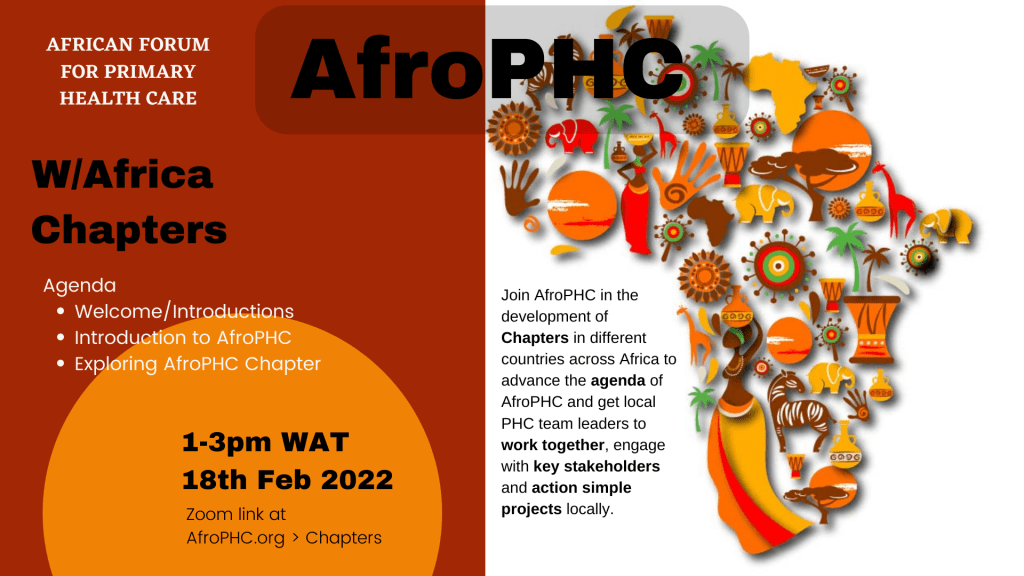
AfroPHC is keen to develop Chapters in different countries across Africa to advance the agenda of AfroPHC and get local PHC team leaders to work together, engage with key stakeholders and action simple projects locally.
The AfroPHC Executive Board has laid out a schedule of meetings over 2022 to support this development. See here. It will run 2-4pm Central Africa Time on the 3rd Friday of every month. All AfroPHC Executive Board members will be there.
Our first meeting for West Africa will be 1-3pm West Africa Time Friday 18th February 2022. See local time here. All AfroPHC members (and anyone else) from the following countries are invited: Nigeria, Ghana, Niger, Guinea, Benin, Burundi, Togo, Sierra Leone, Liberia, Mauritania, Gambia, Cote d’Ivoire, Burkina Faso, Mali, Senegal. There will be French translation. Please feel free to share this with other colleagues in these countries.
Go to to the Chapter Webpage to find the calendar invite and zoom link to join the meeting.
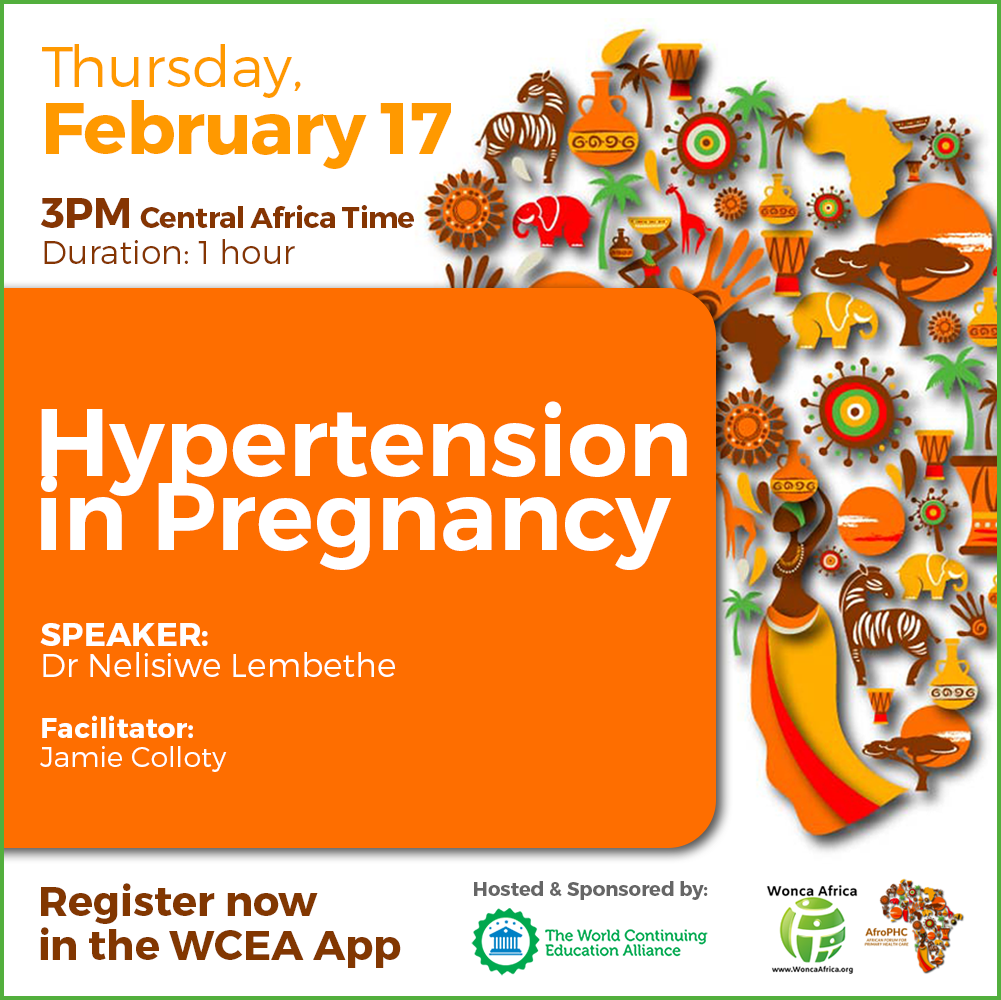
See Dr Nelisiwe Lembethe, a doctor from the District Clinical Specialist Team in Johannesburg Health District, Jhb, SA, talk about the “Hypertension in Pregnancy” at 3 pm on Thursday 17th February 2022 in the CPD webinar of the African Forum for Primary Health Care (AfroPHC). This is accredited for CPD across Africa and accessible via World Continuing Education Alliance.
Join AfroPHC (and indicate your interest) and you will be sent login details within a week. Recordings will be available on the WCEA app. See details on accessing WCEA here.
Artificial intelligence (AI) technologies can improve older people’s health and well-being, but only if ageism is eliminated from their design, implementation, and use, said the World Health Organization (WHO) on Wednesday.
In a new policy brief, Ageism in artificial intelligence for health, the agency presents legal, non-legal and technical measures that can be used to minimize the risk of exacerbating or introducing ageism through AI.
Artificial intelligence is revolutionizing many fields, including public health and medicine for older people. The technology can help predict health risks and events, enable drug development, support the personalization of care management, and much more…..more
AfroPHC is its second interactive AfroPHC Policy Workshop on “Exploring Rehabilitation for PHC/UHC in Africa” 1-4 pm Central Africa Time on Tuesday 15th February. Check your local time here.
After the panel discussion of 1 hour we will break up into small groups with specific facilitators / language groups for 45 minutes to discuss the following question/s. “How do we incorporate rehabilitation professionals into PHC for UHC in Africa?” We will close the meeting with feedback and summarise key issues. We want to build discussions into the draft AfroPHC Policy Document “Building the PHC Team for UHC in Africa”. The panel and feedback will have French translations.
Please register your interest for the Policy Workshops on the AfroPHC policy page. We will provide you the zoom meeting details a few days before the meeting.
COVID-19 has underlined the urgent need to accelerate progress towards universal access to reliable healthcare information. Never before has everyone been so aware of the need for reliable healthcare information, and yet so vulnerable to misinformation.
The new HIFA Strategy 2022-2024 builds on 15 years of solid growth and achievements, including most recently a Statement from the World Medical Association in support of universal access to reliable healthcare information, representing more than 10 million doctors around the world.
The Strategy outlines seven strategic shifts that are necessary to accelerate progress: convene stakeholders; strengthen collaboration with the World Health Organization; promote multilingualism; identify and address priority issues; harness collective intelligence; strengthen advocacy; and protect from misinformation.
As WHO has noted: “Healthcare Information For All is an ambitious goal but it can be achieved if all stakeholders work together.” What is clearly needed now is for all stakeholders to develop and implement a global action plan to improve access to reliable healthcare information and protect people from misinformation. HIFA is ready to promote and drive this process……more
Countries of sub-Saharan Africa are increasingly turning to public contributory health insurance as a mechanism to advance UHC goals. Eight countries in sub-Saharan Africa have introduced national health insurance (NHI) systems, and at least seven more have plans or have passed legislation to establish NHI. By examining the experience of countries that have taken this path, we identify some lessons about whether and how contributory NHI may or may not be a viable path toward UHC in sub-Saharan Africa…..more
Cultural capacity among SBAs is recommended in maternal care to promote culturally safe care and meet the childbearing women’s cultural needs and expectations. This study aimed to explore awareness of cultural practices by skilled birth during pregnancy and birth within the Keiyo community in Kenya.
Methods
A qualitative phenomenological study was conducted between August to December 2019. A semi-structured interview guide was piloted with two SBAs. Individual interviews and data analysis were conducted iteratively. Eleven participants were interviewed, and saturation of themes was achieved after the ninth SBA. Audio recorded data were transcribed and analysed using ATLAS.ti Software version 8.4.4 (1135) that followed Van Manen’s five steps of thematic analysis.
Findings
The three themes that emerged from an inductive and iterative data analysis process were SBAs familiarity with cultural practices, SBAs awareness of cultural practices, women’s expectations of clinical care and challenges to establishing a more collaborative relationship between SBAs, traditional birth attendants (TBAs) and childbearing women.
Conclusion
The SBAs awareness of cultural practices was highlighted through relationships formed during care engagements. This awareness revealed a potential indicator for women’s choice of caregiver. Awareness of threats to cultural safety and fear of disclosure potentially created mechanisms to promote more collaborative care. A broader scope of skilled care approaches requires heightening maternity care providers’ cultural sensitisation to reduce gaps in women’s cultural needs and expectations
New publication shows supervision enhancements and approaches to optimizing health worker performance
A new publication illustrates how insufficient support to build, manage and optimize human resources for health in low- and middle-income countries results in inadequate health workforce performance, perpetuating health inequities and low-quality health services. A systematic review of performance-enhancing health worker supervision approaches in low- and middle-income countries was published in Human Resources for Health and assessed 57 supervision studies since 2010 in approximately 29 countries. It documents supervision enhancements and approaches that improved health worker performance and highlights components associated with these interventions’ effectiveness. Read the publication here.
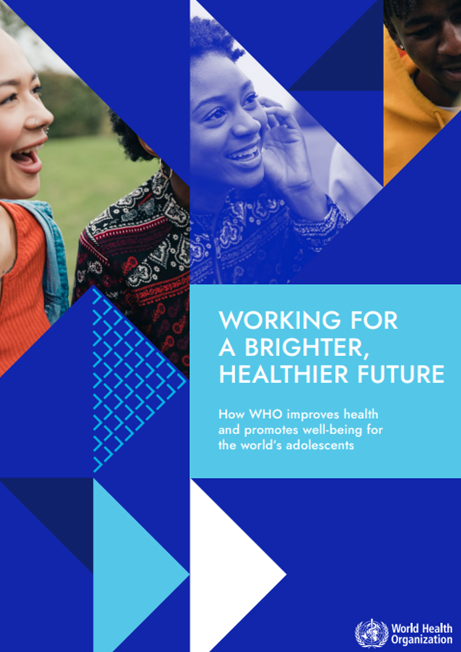
WHO has progressively strengthened its work in adolescent health, growing its portfolio of research, norms and standards, country support and advocacy, and expanding the scope of work across more than 15 departments, spanning all levels of the organization to address the multifaceted needs of the global adolescent population.
Produced by the HQ Interdepartmental Technical Working Group on Adolescent Health and Well-being, this is the first in a future series of biennial reports that describes WHO’s efforts to elevate adolescent health through collaboration and by coordinating new initiatives, expanding the scope of work and establishing ambitious objectives with its development partners and adolescents.
You may find useful the Resource bank in Annex 2 that contains WHO resources on adolescent health including guidelines, training packages and other resources. ….more
Please disseminate widely within your networks.
With best wishes in 2022, On behalf of Valentina/
Valentina Baltag, MD, MSc, PhD Unit Head, Adolescent and Young Adult Health
Department of Maternal, Newborn, Child & Adolescent Health & Ageing World Health Organization 20 Avenue Appia 1211 Geneva 27 Switzerland
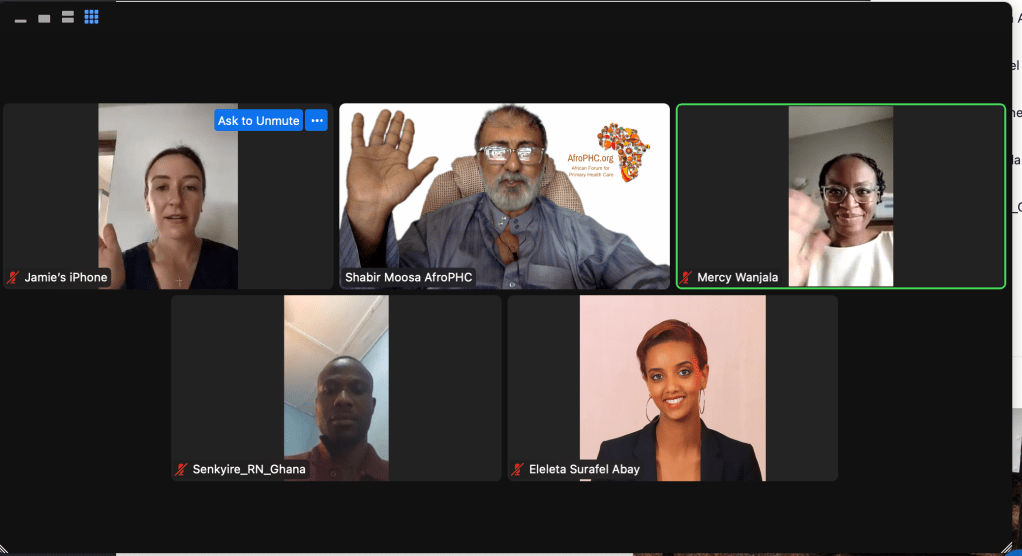
The AfroPHC Executive Coordination Team is growing as young people from across Africa are supporting work in AfroPHC and being capacitated in leadership. Watch out for the future!
I set up a small group of AfroPHC activists who I would like to groom to support me with the organisational tasks I perform as Executive Coordinator – the AfroPHC Executive Coordination Team (ECT). We have met on several occasions to build capacity as well as to help me prepare plans for the AfroPHC Executive Board to approve. A number of AfroPHC members (including from the Youth Hub) have joined. I have tried to develop them in various skills e.g. managing a website, using social media, graphic skills using free/cheap online software, managing minutes/notices, managing zoom etc. They will be expected to voluntarily do small related tasks for AfroPHC under my direction. Hopefully they will become a pool of potential future Executive Coordinators.
See Dr Nirvana Bharuthram, a graduate of the University of the Witwatersrand and currently carrying out her Fellowship in the Division of Rheumatology at the Chris Hani Baragwanath Academic Hospital & the University of Witwatersrand, Jhb, SA, talk about the “Approach to Management of Common Rheumatological conditions in the Primary Health Care setting” at 3 pm on Thursday 9th December 2021 in the CPD webinar of the African Forum for Primary Health Care (AfroPHC). This will be accredited for CPD for South Africa for now but we are busy arranging it via World Continuing Education Alliance for these meetings to be accredited for CPD in many African countries.
Register in advance for this webinar. After registering, you will receive a confirmation email containing information about joining the webinar. The presentation and recording will be below.
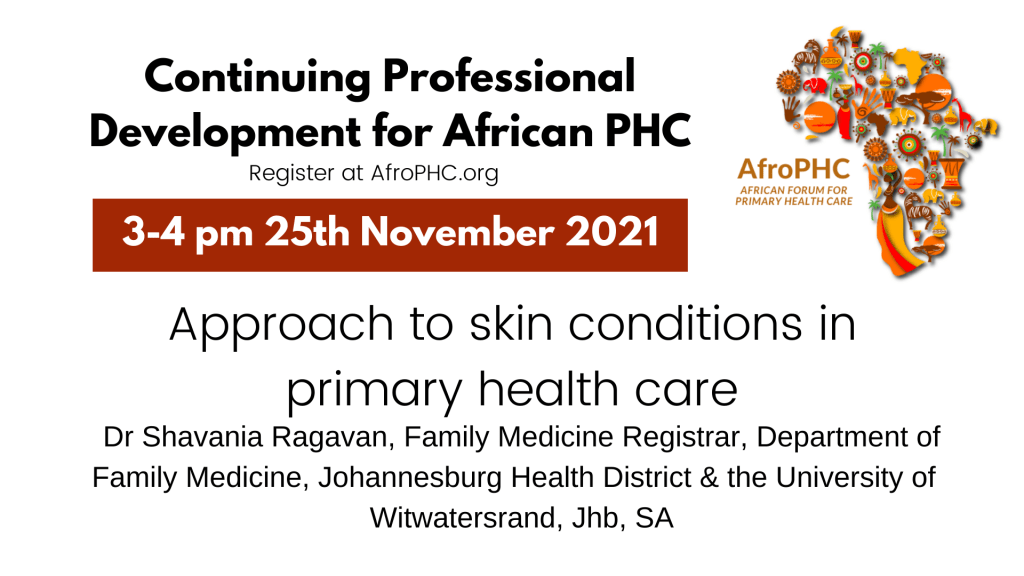
See Dr Shavania Ragavan, Family Medicine Registrar, Department of Family Medicine, Johannesburg Health District & the University of Witwatersrand, Jhb, SA, talk about the “Approach to Skin Conditions in African Primary Health Care” at 3 pm on Thursday 25th November 2021 in the CPD webinar of the African Forum for Primary Health Care (AfroPHC). This will be accredited for CPD for South Africa for now but we are busy arranging it via World Continuing Education Alliance for these meetings to be accredited for CPD in many African countries.
Register in advance for this webinar. After registering, you will receive a confirmation email containing information about joining the webinar. The presentation and recording will be below.
See Dr Ann Alagidede, Family Medicine Registrar, Department of Family Medicine, Johannesburg Health District & the University of Witwatersrand, Jhb, SA, talk about the “Approach to Hypertensive Disorders for Pregnancy in African Primary Health Care” at 3 pm on Thursday 11th November 2021 in the CPD webinar of the African Forum for Primary Health Care (AfroPHC). This will be accredited for CPD for South Africa for now but we are busy arranging it via World Continuing Education Alliance for these meetings to be accredited for CPD in many African countries.
Register in advance for this webinar. After registering, you will receive a confirmation email containing information about joining the webinar. The presentation and recording will be below.
A lecture by Prof Shabir Moosa, Executive Coordinator of the African Forum of Primary Health Care (AfroPHC) on Advancing Primary Health Care in Africa Global Leadership in Nursing And Midwifery Program Course Course.
A lecture by Prof Shabir Moosa, Executive Coordinator of the African Forum of Primary Health Care (AfroPHC) on an Introduction to Primary Health Care for Global Leadership in Nursing And Midwifery Program Course.
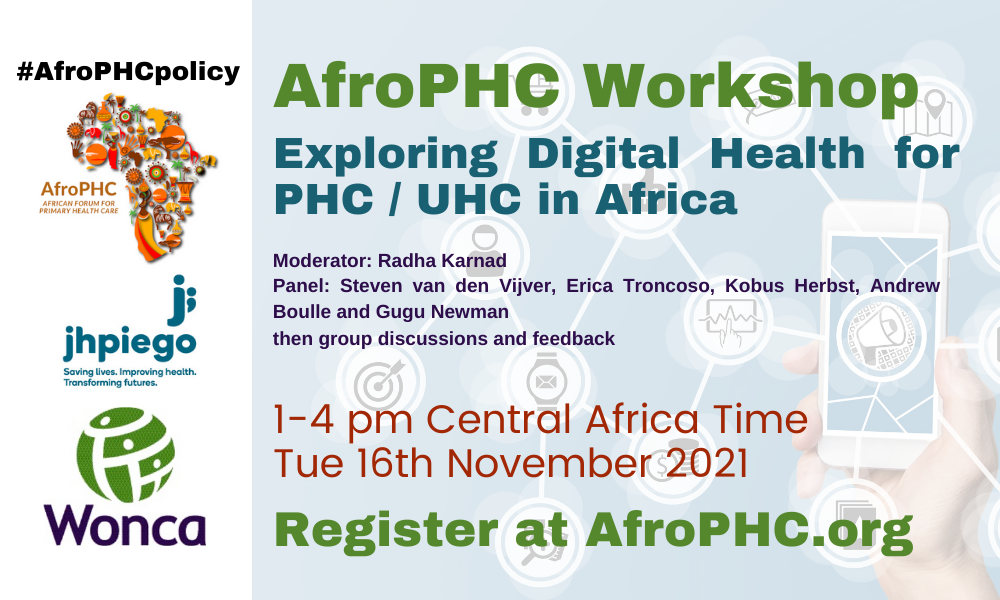
AfroPHC is partnering this month with WONCA eHealth – the Working Party on Digital Health “Rural WONCA” and Jhpiego. We invite you to a joint eWorkshop 1-4 pm Central Africa Time on Tuesday 16th November on “Exploring Digital Health for PHC / UHC in Africa”. Check for your local time here.
Dr Radha Karnad, Executive Board member of AfroPHC will introduce the session and panellists/topics. See detailed profiles of speakers below. It will be very much a conversation rather than a series of presentations.
Dr. Steven van den Vijver “Global view on digital health”
Ms. Erica Troncoso “How best can we use digital health to support primary health care for universal health coverage in Africa?”
Dr. Kobus Herbst “Demographic and Health Surveillance Systems: their relevance for universal health coverage and digital health research
Dr Andrew Boulle “Electronic Health Records in Africa”
Mr Gugu Newman “Blockchain use in African PHC”
We will then break up into small groups with specific facilitators/language groups. for 45 minutes to discuss the following questions.
What digital health technologies do you use in primary health care and how do you use these digital health technologies in primary health care?
Prompt – Brainstorm
What are the benefits of these digital health technologies in primary health care?
Prompt – Is it in clinical service or education
What are the challenges in using digital health for primary health care?
Prompt – Is is capacity or systems?
(How can digital health technologies support universal health coverage in Africa?)
We will close the meeting with feedback and summarising key issues.
We are hoping that the full meeting will have French translations. We will have four English Discussion Groups but also one in French and one in Portuguese. We hope to publish the findings as research after your oral consent is recorded. Data will be totally anonymised.
Register below. We will send link before the meeting.
Dr. Radha S. Karnad, BA BM MPH, has over a decade of experience developing innovative approaches to clinical medicine in hospital and community settings, healthcare program management, quality improvement, and human resource for health capacity building across the US, UK, and East Africa. A registered public health clinician, she is passionate about maternal and reproductive health, and believes that it is only by improving health systems that we will find solutions to global public health problems and improve access to health. Dr Karnad provides clinical oversight and governance to a team of clinicians and care coordinators at HealthX Africa, a population health management organization providing access to affordable and high quality primary health care across Kenya through digital health solutions. She ensures essential service delivery for preventive, promotive, and curative services at the community and primary health care level, strengthening health systems that are client-centered, coordinated, and comprehensive. Dr. Karnad works with stakeholders across all levels of the health system to institutionalize healthcare innovations in maternal, newborn, and adolescent health. She is an Acumen East Africa Regional Fellow 2016 and an Afya Bora Consortium Global Health Leadership Fellow 2016-2017, and an ISQUA Fellow.
Steven van de Vijver (1977) is working as a family doctor and director of the Family Medicine Department at the OLVG hospital in Amsterdam, The Netherlands. In addition he works as a Senior Advisor at the Amsterdam Health & Technology Institute (www.ahti.nl) where he is guiding several innovative projects in the field of primary care.
In the past he received his PhD during his three year stay at the African Population and Health Research Center (www.aphrc.org) on the design, implementation and evaluation of cardiovascular prevention for the urban poor in Nairobi, Kenya.
Currently his specific interest is innovations in digital health within various projects. This ranges from the implementation of a home based management tool for hypertension until the development and implementation of a mobile medical health records for migrants.
His aim is to support the implementation and research of innovations in primary care due to technology and digitization in order to increase access and quality of care for the most vulnerable.
Erica currently leads Jhpiego’s initiative on emerging technology and frontier solutions as a digital health and innovations advisor for global programs, specializing in implementing the appropriate use of cutting-edge technology at the facility level and with the health workforce. Working across the spectrum of emerging technologies, Erica focuses on implementing innovations in low-resource health care settings, particularly within areas of family planning, maternal health, and HIV treatment/prevention.
Kobus Herbst is the Director of the DSI-funded South African Population Research Infrastructure Network (SAPRIN). SAPRIN is hosted by the South African Medical Research Council and funds the population and health surveillance at five nodes (Agincourt, Mpumalanga; DIMAMO Limpopo, AHRI KZN, GRT-INSPIRED Gauteng, and C-SHARP WC.
He is a Faculty member and the Director Population Science at the Africa Health Research Institute and the principal investigator of its Population Intervention Programme (PIP). He is honorary professor at the University of Limpopo. Kobus graduated as a medical doctor from the University of Pretoria in 1979, did a masters in Bioengineering at the University of Cape Town and registered as a public health physician in 1994 following a registrarship at MEDUNSA.
Kobus’s passion is information and how information management contributes to the scientific process. In particular the establishment of data repositories to curate datasets and promote the secondary use of research study data. To this end Kobus established the INDEPTH data repository in 2013 containing longitudinal demographic and cause-specific mortality data of more than 3 million individuals from 25 demographic surveillance sites in lower and middle-income countries. This work is extended in a collaborative project with researchers at LSHTM to establish a repository of longitudinal population-based HIV sero-surveillance data from 10 sites in Africa (the Alpha network). His research goals are: the use of large longitudinal population studies in resource limited settings to explore causes of mortality and obstacles to access care and support through the linkage of population data with service utilisation data; and how to fairly and responsibly improve access by data users to such population data resources. A list of his research publications can be found at: ResearchGate
Gugu Newman Nyathi is Co-Founder and COO of Ribbon Blockchain Pty Ltd, a for profit social enterprise that utilizes Blockchain Technology to integrate and automate public health systems towards efficiency and data driven insights for improved health outcomes. Gugu is an Entrepreneur with a passion for innovation and emerging technologies and how they intersect with the real and virtual world across global and public health.
Professor Andrew Boulle is from the School of Public Health and Family Medicine, University of Cape Town. He is an accomplished researcher. See his Google Scholar Profile.
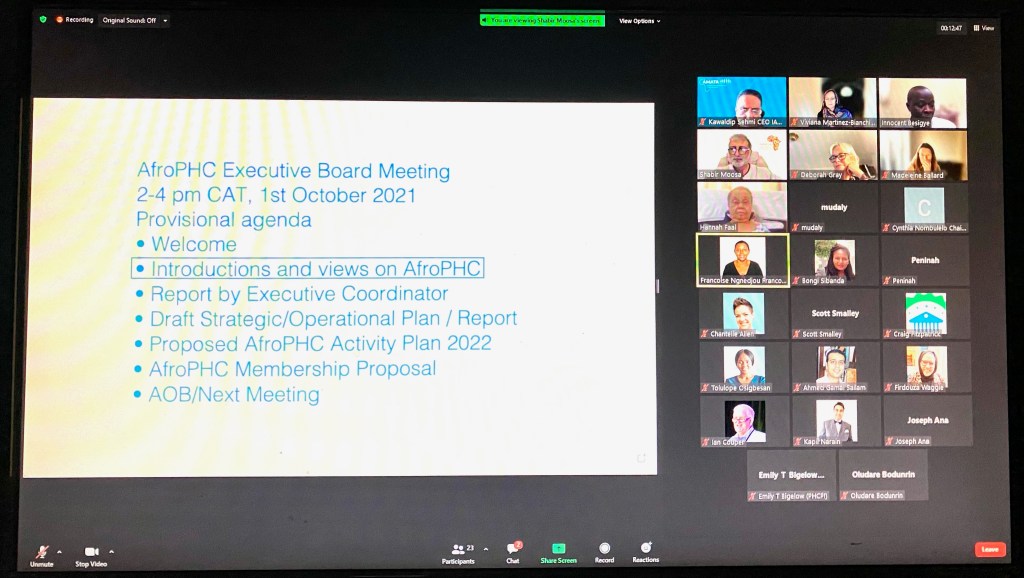
AfroPHC has garnered 31 organisations that are willing to publicly support AfroPHC and its objectives. They are depicted on the home page in a carousel of their logos. Click here to visit their websites. We have also chosen an Advisory Board from these Supporting Organisations and other experts across Africa and the world. You can see the full list of our Executive Board Members and Advisory Board Members on the About AfroPHC page. You can see brief details and pictures of each Board member by clicking on their names. The Executive Board has been meeting monthly on the first Friday afternoon of every month and constituted the Advisory Board in September after a few months recruiting Supporting Organisations and preparing nominations for the Advisory Board. The Advisory Board is a rich assembly of expertise, experience and interest. The Executive Board met with the Advisory Board for the first time on Friday 5th November, as one of its regular six-monthly meeting. Most members were present and it proved to be very rich and satisfying to attendees. It was an introductory meeting so we are sharing a recording of the introduction part including a brief report on AfroPHC to the Advisory Board.
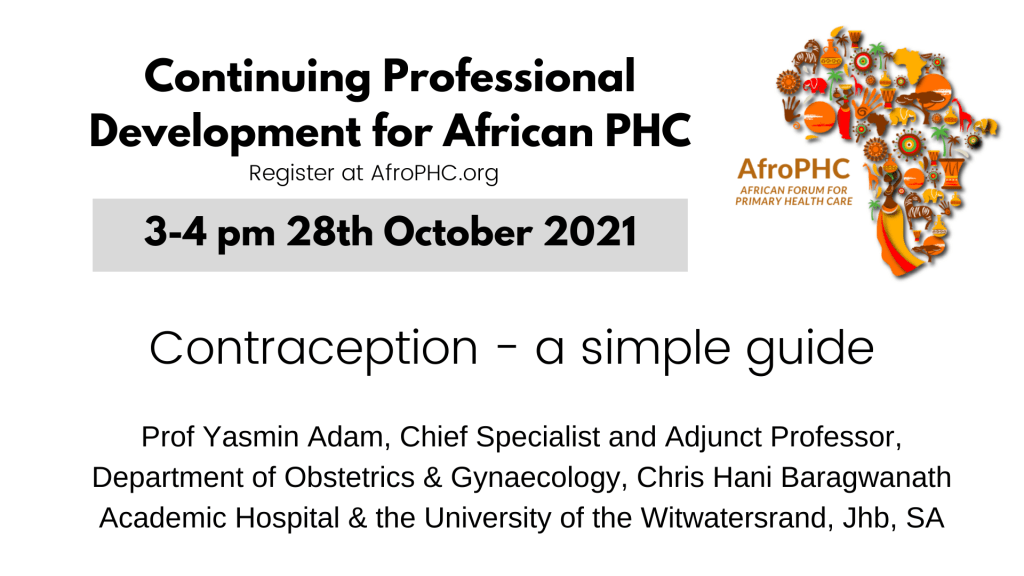
See Prof Yasmin Adam, Chief Specialist and Adjunct Professor, Department of Obstetrics & Gynaecology, Chris Hani Baragwanath Academic Hospital & the University of the Witwatersrand, Jhb, SA, with interests in contraception, prevention of cervical cancer, stillbirths and maternal morbidity talk about the “Contraception – a simple guide” at 3 pm on Thursday 28th October 2021 in the CPD webinar of the African Forum for Primary Health Care (AfroPHC). This will be accredited for CPD for South Africa for now but we are busy arranging it via World Continuing Education Alliance for these meetings to be accredited for CPD in many African countries.
Register in advance for this webinar. After registering, you will receive a confirmation email containing information about joining the webinar. The presentation and recording will be below.
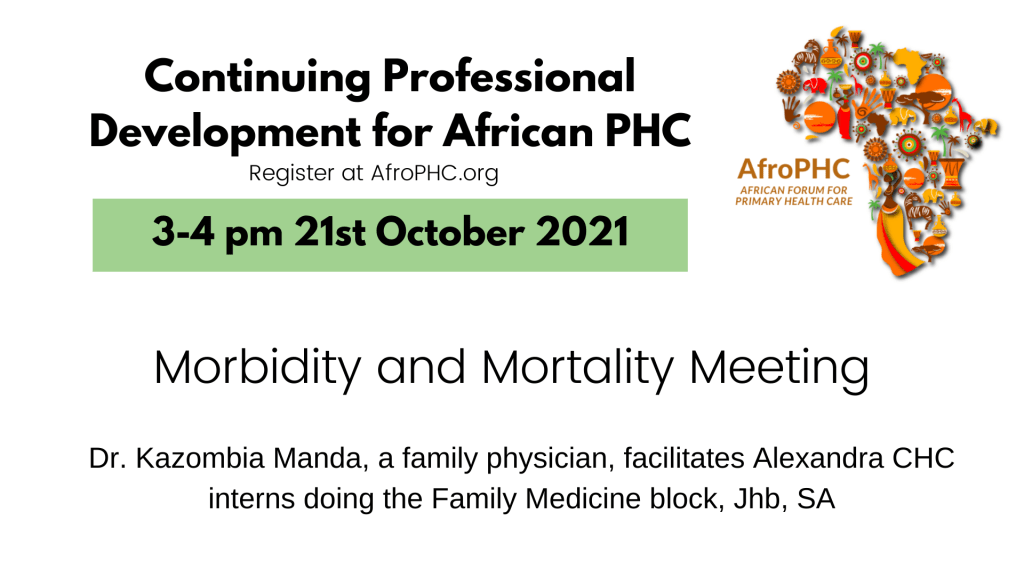
See Dr. Kazombia Manda, family physician from Johannesburg Health District and University of Witwatersrand, Jhb, SA, facilitate interns from Alexandra CHC in a “Morbidity and Mortality Meeting” at 3 pm on Thursday 21st October 2021 in the CPD webinar of the African Forum for Primary Health Care (AfroPHC). This will be accredited for CPD for South Africa for now but we are busy arranging it via World Continuing Education Alliance for these meetings to be accredited for CPD in many African countries.
Register in advance for this webinar. After registering, you will receive a confirmation email containing information about joining the webinar. The presentation and recording will be below.












 AfroPHC