
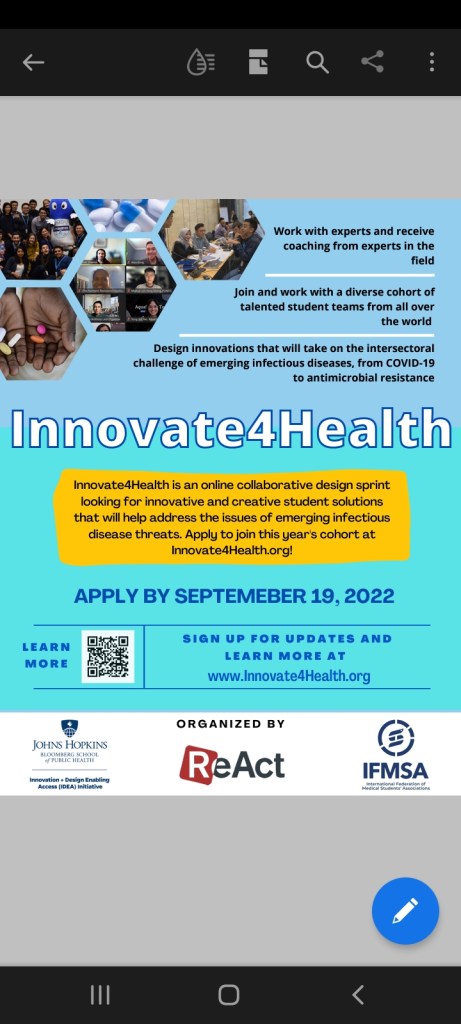
Call for student team applications: Innovate4Health 2022

Organized by the ReAct—Action on Antibiotic Resistance, the International Federation of Medical Students’ Associations (IFMSA), and the IDEA (Innovation + Design Enabling Access) Initiative at the Johns Hopkins Bloomberg School of Public Health, Innovate4Health offers student teams the opportunity to join the front lines of the fight against antimicrobial resistance and COVID-19. This year, student teams are encouraged to innovate around one of three pillars: 1) Ensuring effective prevention and treatment of emerging infectious diseases in the healthcare delivery system; 2) Reducing the use and the need to use antimicrobials in food systems; and 3) Making community health systems more resilient to emerging infectious diseases.


Taking a systems approach, Innovate4Health emphasizes social innovations that consider the needs of resource-limited settings. We are looking for student teams (2-5 students per team) with ideas for innovative solutions and an interest in continuing to develop and refine their ideas in a design sprint curriculum. Through the design sprint, teams will work through ideation, implementation, and advocacy strategies to support the adoption of these approaches. We have continued to evolve the design sprint’s activities to strengthen its value for participating teams. This year’s cohort will have the opportunity to develop stage-specific strategies to write a blog advancing the social mission behind the team’s innovation; prepare a poster presentation of their project; and put together a social media advocacy piece. A group of experts will coach the team on its final presentation, which will be shared as a recording. The selected teams will work with a team of experts and coaches to co-construct their solutions through both recorded and live learning sessions. We invite applications from teams that would be excited to collaborate with other highly talented student teams. The design sprint will extend from October 2022 through January 2023.


Students do not need any previous experience involving antimicrobial resistance (AMR) or other emerging infectious diseases. In the competitive application process, we are looking for student teams providing a vision for what they might want to innovate, including the specific problem and context, as well as sharing how they might be positioned to help implement such a project. At the application stage, however, we do not expect fully developed projects. The design sprint process is intended to help teams develop further their ideas from the application stage. We have outlined additional information for Innovate4Health on our website, http://www.innovate4health.org. There, you will also find more background information on Innovate4Health, as well as the design sprint timeline, Terms and Conditions, and submission guidelines. Last year, over 70 student teams answered our call for Innovate4AMR applications, and only 15 finalist teams were selected.


The deadline for team applications is Monday, September 19, 2022. We will be releasing additional resources to support teams in developing applications, and interested students can sign up for updates here.

Antibiotic Failure Will Kill 10 Million People a Year by 2050

‘If present trends continue, antibiotic failure will claim 10 million lives per year by 2050, the report concludes. That’s more carnage than what’s currently caused by cancer and traffic accidents combined. The economic toll will also be mind-boggling. By 2050, the report estimates, antibiotic resistance will be incurring $8 trillion in annual expenses globally. That’s equal to nearly half of the total output of the US economy in 2014—an enormous hemorrhaging of global resources.’

Meanwhile, there is woefully inadequate political and financial support for the action plan recommended by WHO. One of the most urgent and most achievable actions is to ensure access to reliable, unbiased information. As WHO has proclaimed: “Appropriate use of antibiotics is only possible if healthcare workers and the public have access to reliable, unbiased information on medicines. Universal access to reliable information on medicines is readily achievable and should be a cornerstone of efforts to promote rational prescribing. There is an urgent need for concerted action.”

http://www.who.int/rhem/didyouknow/essential_medicines/rational_antibiotic_use/en/

HIFA has a dedicated Working Group looking at this issue:

http://www.hifa2015.org/prescribers-and-users-of-medicines/

I invite you to look at this 2-minute video: Will you be an Antibiotic Guardian?

https://www.youtube.com/watch?v=HN5ultN7JaM

The video talks about the growing global threat of antimicrobial resistance and the three steps that every global citizen needs to take to prevent it:

1. Don’t demand antibiotics

2. Take antibiotics exactly as prescribed. Never save them for later. Never give them to anyone else.

3. Spread the word – tell your friends and family to use antibiotics properly.

The video is part of a campaign by Public Health England, described here:

Antibiotic Resistance: why the fuss and what simple actions can everyone take?

http://longitudeprize.org/blog-post/antibiotic-resistance-why-fuss-and-what-simple-actions-can-everyone-take

In my view, this needs to be a global message, promoted by the World Health Organization, International Network for the Rational Use of Drugs, HIFA and others. WHO has a multifaceted policy to prevent antimicropial resistance, which includes access to reliable information on medicines, but this policy is not adequately supported nor implemented. http://www.who.int/world-health-day/2011/policybriefs/en/

One of the easy wins – and especially relevant to HIFA – is that every prescriber and every user of medicines should have easy access to the information and knowledge they need to use antibiotics effectively (including the very basic information given in the above video). It is shocking but true that most prescribers do not have access to reliable information, even those who have internet access. For example, UK prescribers get reliable, independent information free (British National Formulary), but such information is currently behind a pay-wall and/or is unaffordable and/or is difficult to use for the vast majority of prescribers worldwide. Mamy, many prescribers worldwide rely on drug promotion literature – whose sole aim is to encourage more use of their antibiotic!

HIFA has a working group on Information for Prescribers and Users of Medicines and we would welcome new members to work with us towards the goal of Information on Medicines For All. You can read more here: http://www.hifa2015.org/prescribers-and-users-of-medicines/?

Best wishes,

Neil

Let’s build a future where people are no longer dying for lack of healthcare knowledge – Join HIFA: www.hifa2015.org  

………

Below are extracts from a news item on the Reuters website. Rational use of antibiotics, supported by universal access to reliable information for prescribers and users, is one of several priorities identified by WHO to help prevent the emergence of superbugs.

‘LONDON, Dec 11 (Reuters) – Drug-resistant superbugs could kill an extra 10 million people a year and cost up to $100 trillion by 2050 if their rampant global spread is not halted, according to a British government-commissioned review.

‘Such infections already kill hundreds of thousands of people a year and the trend is growing, the review said, adding: “The importance of effective antimicrobial drugs cannot be overplayed.”…

‘The World Health Organization has warned that a post-antibiotic era, where basic healthcare becomes far more dangerous due to risk of infection during routine operations, could arrive this century unless something drastic is done…’

Let’s build a future where people are no longer dying for lack of healthcare knowledge – Join HIFA: www.hifa2015.org