Major Global Trends to Look Out for in Primary Health Care 2025
Check date/time for your time zone Your Date and Time Zone Here
Aim: To explore the major emerging global trends that will impact primary care and primary health care (PHC) in 2025 and beyond, and discuss strategies for PHC adaptation and transformation in response to these trends. Objectives:
To identify key global trends that will shape primary health care in 2025.
To discuss the challenges and opportunities these trends present for PHC workers and health systems in Africa.
To explore practical strategies for adapting to these trends and strengthening PHC resilience.
Join us as we explore the future of Primary Health Care and strategize for a resilient healthcare workforce in Africa!
Africa, a continent of unparalleled diversity and dynamism, stands at a critical juncture in its health care journey. Universal Health Coverage (UHC) remains an aspiration for many African nations, and achieving it requires an approach that is both strategic and contextually appropriate. The AfroPHC Policy Framework emerges as a beacon in this endeavor, illuminating the path towards a health care system that is not only universally accessible but also tailor-made for the unique needs and challenges of the African context.
Originally drafted by Prof. Shabir Moosa, this groundbreaking document is a culmination of insightful discussions, views, and conclusions from the AfroPHC policy workshops held in 2021. This framework is not just a document; it’s a call to action for Africa to be deliberate about UHC by fostering Primary Health Care (PHC) teams that are not only fit for purpose but also intricately tailored for the multifaceted African context. The AfroPHC Policy Framework underscores the importance of robust, community-oriented, and adaptable primary health care systems as the backbone of UHC in Africa.
Prof. Moosa, in collaboration with various stakeholders, infused the framework with rich discussions, views, and conclusions from the policy workshops. These sessions saw vibrant interactions, insightful debates, and the collective wisdom of health professionals, policy-makers, academics, and community representatives, all harmonized into a coherent policy guide.The central tenet of the AfroPHC Policy Framework is simple yet profoundly transformative: to be intentional about UHC by building and adequately supporting Primary Health Care (PHC) teams that are fit for purpose and resonate with the African milieu.
Why is this Framework Crucial? The essence of Universal Health Coverage lies in its inclusivity. Every individual, regardless of their socio-economic background or geographic location, should have access to quality health care without facing financial hardship. However, the generic blueprint for UHC may not effectively address the distinct challenges faced by the African populace. This is where the AfroPHC Policy Framework steps in, emphasizing the need for:
PHC Teams that Understand the Ground Reality: The continent’s health care nuances, from endemic diseases to infrastructural limitations, require teams that are trained, equipped, and motivated to work in the African context. Evidence shows that team based care results in better health outcomes and is more efficient and effective.
Cultural Sensitivity: Africa’s rich tapestry of cultures demands health care approaches that respect and integrate traditional beliefs and practices.
Local Ownership and Empowerment: Rather than imposing external models, there’s a pressing need to empower local communities to have a stake in shaping their health care systems.
Join the Conversation in Sydney, Australia- WONCA World Conference 2023: The AfroPHC Policy Framework is not just a document; it’s a movement. We invite all stakeholders, from health care professionals to policymakers, to delve into this framework and contribute to the discourse. Your insights, experiences, and expertise are invaluable in refining and implementing this vision.
A workshop will be held in Sydney, providing a platform for robust discussions, exchange of ideas, and collaborative strategizing. Be part of this transformative journey and play a role in reshaping Africa’s health care future.
Let’s be intentional. Let’s be African-centered. Let’s pave the way for a UHC that truly serves the heart of Africa.
For more details on the Sydney workshop click here.
TITLE: BUILDING EFFECTIVE MULTIDISCIPLINARY PRIMARY HEALTH CARE TEAMS FOR UNIVERSAL HEALTH COVERAGE IN AFRICA – A CASE OF ISTH FAMILY MEDICINE OUTPOST, IGUEBEN, EDO STATE, NIGERIA
ABSTRACT
In Nigeria, like most African countries, the Primary Health Care (PHC) centres are unable to address the health needs of rural dwellers as they lack adequate staff and equipment. We were able to bring accessible and affordable health care services to the people of Igueben in Edo State, Nigeria using a multidisciplinary team headed by Family Physicians from the department of Family Medicine, Irrua Specialist Teaching Hospital (ISTH), Irrua, Edo State, Nigeria. This followed request from the community. The team comprised Family Physicians, nurses, administrators, and community leaders. We established an outpost where most common medical and surgical conditions were managed at minimal rates. More serious cases that could not be handled at the outpost were referred to ISTH. This ensured access to quality healthcare for the people within their reach and means. Collaborating with other health workers as well as community leaders is essential for achieving universal health coverage.
ABOUT THE WINNER
Dr Tijani Oseni is a lecturer and Consultant Family Physician/ Head, Lifestyle and Behavioural medicine Unit, Department of Family Medicine, Ambrose Alli University, Ekpoma/ Irrua Specialist Teaching Hospital, Irrua, Nigeria. He is a fellow of the National Postgraduate Medical College of Nigeria (FMCFM) and currently doing a PhD programme in Social and behavioural Medicine in the University of Calabar, Nigeria. His research interests are Family Medicine Education, Lifestyle and Behavioural Medicine, Sexual and Reproductive Health and Primary Health Care. He is the Assistant Head, AfroPHC Research Team; a member of the WONCA Working Party on Research; Head Afriwon Research Group; and Research Secretary, Society of Lifestyle Medicine of Nigeria (SOLONg). He teaches Family Medicine and mentors undergraduate and postgraduate medical students. He is passionate about rural Family Practice where he seeks to use effective low cost behavioural and lifestyle approach to bring about improved health care to the rural populace.
AfroPHC has been developing a primary healthcare policy framework that is being launched on the 14th of March 2023. The framework consists of 31 main points/goals plus an opening and closing. Now, we are hosting a competition to create videos for each of the 33 points.
This competition is for healthcare students and professionals in Africa. Participation will be in groups and to participate, the group leader has to register below and download the video scripts document. This document has 33 scenes, one for each of the 33 points in the policy framework. In the scripts document, the policy framework points are in given in peach background. And this document can be downloaded here: https://drive.google.com/file/d/1tcbBgmYaFECY3v3UPXveiBGssCnKue39/view?usp=drivesdk
The participants are to shoot 5 videos for any 5 scenes directed in the scripts document. Each video should be atleast 15 seconds and atmost 30 seconds long (15-30 seconds long). The participants are to shoot the videos as directed in the scripts. They are free to make slight changes, the number of the main cast in the introduction and closing scenes can be reduced to 5. If participants feel like they can do one or more of the scenes in a better way than the one directed, they should email their suggested script(s) to innocential@innocentialdiaries.xyz for approval first before shooting. Such scripts will not be shared with other participants.
The participants are expected to collaborate with their healthcare centers for the video shooting and the equipment required. The scripts documents lists the extra requirements that might not be available in a healthcare center. Anyone can play any role given in the scripts document. However, identity clothing is required for each specified role. For example, a student nurse can act as a doctor in the play provided he dresses as a doctor in that play. The videos are to be simple and there’s no need for professional equipment or editing.
Technical requirements include:
Minimum resolution of the video of at least 720p.
The videos should have an aspect ratio of horizontal 4:3.
A maximum file size of 300MB, while utilizing commonly used video-codecs (e.g. H.264) and formats (.mov or .mp4).
Audio with a minimum bitrate of 128kbps.
Do not add text or watermarks or logos on the videos.
Only the calls should be cited in the videos. The words spoken in the videos should only be the calls recited.
The videos should not be significantly inclined torwards one gender.
Name the video files according to the scene titles given.
After shooting the 5 videos, the participants must put them in a Google drive folder and email the link to innocential@innocentialdiaries.xyz. Make sure this email has been granted access to the folder. These 5 videos should be submitted before the deadline, 12 February 2023, 2359hrs GMT+2. We will then shortlist two teams, and these two teams would have to shoot the videos for the remaining 28 scenes (to make a total of 33 videos, one video for each of the scenes given). They are to submit these videos as described above before the deadline, 28 February 2023, 2359hrs GMT+2.
The winners will be announced within a week, on this page and on our social accounts. There will be 2 winners. The 1st place will be awarded $500US. The second place will be awarded $250US. The ranking will be done by a set of judges and it will be based on creativity, quality and excellence. The winning participants will be required to grant AfroPHC the copyrights and ownership of their video content before being awarded the cash prizes.
One solution proposed by some surgical experts is to devolve less-complicated surgical procedures to district hospitals closer to patients. The AfroSurg3 Conference held at the end of September, however, shed some light on the often suboptimal conditions for surgical care at district hospitals, especially in rural areas, and showed that it will take time, effort and resources to make such an approach work……more
The African Forum for Primary Health Care (AfroPHC) will be convening a Final Consultation Workshop on 25th and 26th October 2022 in Johannesburg to conclude the extensive consultation process for the AfroPHC Policy Framework being developed. About 35 members of the AfroPHC Executive and Advisory Board are expected to participate, together with other key stakeholders and experts, as the first in-person meeting of AfroPHC.
In order to enhance the workshop there will be two public seminars/webinars 8-10pm South African time on 24th and 25th of October at the auditorium of Wits School of Public Health.
24th October
Prof. Kara Hanson: Overview of Lancet Global Health Commission Report on PHC Financing
Dr. Oludare Bodunrin: Overview of African Strategic Purchasing for PHC in Africa
25th October
Prof Shabir Moosa: Overview of National Health Insurance and PHC efforts in South Africa, including Proof of Concept in Johannesburg
She has spent the last 30 years researching the economics of health systems in low- and middle-income countries. Her major contributions are in the areas of health financing and the private health sector. She chaired the recent Lancet Global Health Commission on Financing Primary Health Care, and have authored key publications on how strategic purchasing can help to improve health system performance. Her work on the private sector has contributed to understanding of the opportunities and limitations of using the private sector to extend access to critical public health interventions and, more recently, to the challenges of regulating healthcare markets. She frequently advise national governments and international organisations on health system and financing issues. She is President-Elect of the International Health Economics Association.
Dr. Oludare (‘Dare) Bodunrin
Over the last decade, Oludare Bodunrin has been working on strategic initiatives to deliver quality health care to underserved populations in Nigeria. Fondly called ‘Dare, he currently serves as the Acting Director and Technical lead at the SPARC, a strategic purchasing initiative hosted by Amref Health Africa to broker support to countries as they design and implement reforms geared towards efficient and equitable use of financial resources for health. Before joining SPARC, he served as a senior program officer at the Results for Development (R4D) in Nigeria during which he led the design and implementation of Social Health Insurance Schemes, facilitated joint learning about sub-national healthcare policy makers and managed key program functions as country representative of R4D Nigeria. ‘Dare’s professional interest and experience includes, health insurance design and implementation, supply chain for healthcare commodities, primary healthcare systems strengthening, private sector engagement and Not-for-Profit Management. He strongly advocates for self-sufficiency, mutually beneficial partnership and home-grown evidence-based solutions for sustainable development in Africa
Prof Shabir Moosa
Prof Shabir Moosa is a family physician with an MBA and PhD. He works in public service clinics of Soweto and at the University of Witwatersrand, Johannesburg, South Africa. He has extensive experience in rural general practice and the development of family medicine and primary care services in both rural and urban district health services in South Africa and Africa. Shabir is involved in development and research around family medicine, community-oriented primary health care (COPC) and health management for Universal Health Coverage (UHC) in Africa. He is Member at Large in the Executive Committee of WONCA (World Organisation of Family Doctors), and Executive Coordinator of AfroPHC, the African Forum for Primary Health Care (PHC), bringing African PHC team leaders together to advocate for PHC and UHC
Join us at our next interactive AfroPHC Policy Workshop on “Bridging the Gap: Health Equity in PHC in Africa” 11am-2pm Ghana, 12pm-3pm Nigeria, 1-4 pm Central/Southern Africa and 2-5pm Kenya next Tuesday 18th October. Check your local time here. Link below
Our panel, moderated by Ms. Rawia Kamal, is made up of the following expert: Morrish Humphrey Ojok, Kim Yu and Viviana Martinez-Bianchi.
After the panel discussion of 1 hour, we will break up into small groups with specific facilitators / language groups for 45 minutes to discuss the following question/s.
In your experience, what are the factors that have contributed to health disparities and inequities in the access and delivery of primary health care from:
A community perspective?
A healthcare worker/ service delivery perspective?
What are some of the solutions you would recommend addressing these gaps and promote health equity?
We will close the meeting with feedback and summarise key issues. We want to build discussions into the draft AfroPHC Policy Document “Building the PHC Team for UHC in Africa”. The panel and feedback will have French translations. See more details, including speaker’s bios below.
Morrish Humphrey Ojok Country Manager Amref Health Africa in South Sudan. Morrish Humphrey Ojok serves as the Country Manager of Amref Health Africa in South Sudan. Morrish is an experienced leader in the field of global public health, health in emergencies and sexual and reproductive health and international development. He has extensive experience in driving complex programme deployment, monitoring and evaluation, strategic planning, and management in multiple countries. Morrish has over 17 years’ experience developing and delivering organizational strategies, with extensive experience of complex management and governance issues. He strongly believes that its through Primary Health Care that Universal Health Coverage can become a reality in Africa. He also believes that through partnership and collaboration with all stakeholders at all levels from community level, Government, private sector and with support from the broader international community and donors, innovative, culturally sensitive, and appropriate solutions to Africa’s health challenges can be found and fostered.
Dr. Kim Yu: Board certified in family medicine, Dr. Kim Yu is National Director for Clinical and Community Partnerships for Aledade, based in Orange County, California. Dr. Yu speaks internationally and trains family physicians, residents and medical students on health equity, population health, value-based care, health IT, leadership, advocacy, disaster relief, social media, and physician wellness. Dr. Yu currently serves as President of the Orange County Chapter of the California Academy of Family Physicians; She also chairs WONCA’s Special Interest Group in Health Equity and is AAFP delegate to the AMA. She is past president of the Michigan Academy of Family Physicians.
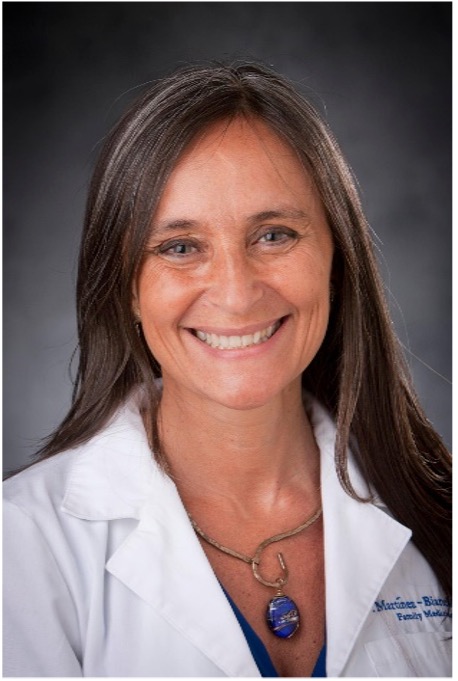
Dr. Viviana Martinez- Bianchi: Dr. Viviana Martinez-Bianchi is an associate professor in Duke’s Department of Family Medicine and Community Health, and named North Carolina’s 2021 Family Physician of the Year by the North Carolina Academy of Family Physicians (NCAFP). The honor is the most prestigious award from the NCAFP, the state’s largest specialty medical association, comprised of more than 4,300 members. Dr. Martinez-Bianchi, a family physician committed to health equity in her community and around the world, serves as Director of Health Equity for the Department of Family Medicine and Community Health at Duke University. She is a co-founder of the Latinx Advocacy Team & Interdisciplinary Network for COVID-19, better known as LATIN-19. The group was established in March of 2020 to address inequities in the COVID-19 pandemic response, the health system in general and communities in Central North Carolina. Prior to becoming Director of Health Equity, Dr. Martinez-Bianchi served as Program Director for the Duke Family Medicine Residency Program.
This eighteen-months Post-doc position will support the work of the research vision and objectives, data and methodology, and omics workstreams of the CE-APCC. The work will happen in several phases with the first phase a landscape review of population cohorts in Africa with regards to their research visions and aims, scope for data and methodological harmonization, and opportunities for omics approaches. During the second phase, the candidate will organize and facilitate a series of thematic workshops with stakeholders in Africa to discuss and enhance the landscape review. This information will be summarized in a participatory pathway impact analysis. The third phase will build a consensus on the research vision and objectives for the APCC and opportunities for omics, data, and methodological advances. In the final phase the candidate will participate in the writing of the final APCC blueprint. The candidate will work with three other postdoctoral fellows on this project who are based in Malawi and Kenya.
This is an exciting opportunity for a postdoctoral candidate to work directly with leading scientists in Africa in the fields of population, public health, data, and omics sciences. The candidate will work under the direct supervision of Dr Kobus Herbst, the co-lead of the CE-APCC; Drs. Anjali Sharma, Jacques Emina and Mercy Wanjala, conveners of the Research Vision and Objectives workstream; Drs. Agnes Kiragga and Sikhulile Moyo, co-leads of the Data & Methodology workstreams; and Prof Michele Ramsay, lead of the Omics workstream.
It is an unprecedented opportunity to explore the research landscape of the most important population cohorts, including the more than 30 health and demographic surveillance systems in Africa and build an invaluable network of scientists in Africa as a resource for a scientific career that will positively impact of the health and wellbeing of the African population. This work will result in several publications documenting the landscape review and the process of establishing the APCC.
Qualifications and experience:
PhD in a relevant subject Strong systematic review skills Ability to prepare results for publication and draft own manuscripts Excellent written and oral communication skills Self-motivated, able to work independently and as part of a multidisciplinary team Good interpersonal skills and team orientated Please click here to apply. Closing date is Friday, 21 October 2022.
The salary for this position depends on previous experience and brackets are according to AHRI’s official scheme and NRF grades, which will be without tax deduction due to tax exemption status for postdoctoral fellows.
Join us 1-3pm GMT this Friday 30th September to meet with as many colleagues from our Supporting Organisations https://atomic-temporary-69625775.wpcomstaging.com/supporting-organisations/ [with English-French translators]. The consultation will be facilitated by members of the Executive Board. The agenda is as follows. The link is below
Welcome/Introductions
Introduction to AfroPHC and Chapter Discussions on “What are the challenges of PHC in the region?”
Review of AfroPHC Policy Framework Discussions on “The Draft Policy Framework: what we like, don’t like and suggestions”
Join the AfroPHC WhatsApp groups and engage in discussions before and after our consultations https://chat.whatsapp.com/GV7f8h3T4vpAMYixbMCMiC See more here [https://atomic-temporary-69625775.wpcomstaging.com/chapters/].
We are very keen that as many local stakeholders participate. These include professional associations, ministries of health, accreditation / certification bodies, academics, patient advocacy groups etc. Please feel free to share this email to any key stakeholders you think should be there and ask them to join us to discuss AfroPHC and the Policy Framework.
Rejoignez-nous ce vendredi pour consulter les organisations de soutien
Nous tenons vraiment à ce que le plus grand nombre de personnes s’engagent avec AfroPHC et le projet de cadre politique. Vous pouvez faire un commentaire ici.
Rejoignez-nous de 13h à 15h GMT ce vendredi 30 septembre pour rencontrer autant de collègues de nos organisations de soutien https://atomic-temporary-69625775.wpcomstaging.com/supporting-organisations/ [avec des traducteurs anglais-français]. La consultation sera animée par les membres du Conseil d’administration.
L’ordre du jour est le suivant. Le lien est ci-dessous
• Bienvenue/Présentations
• Introduction à AfroPHC et discussions de chapitre sur « Quels sont les défis des SSP dans la région ? »
• Examen des discussions sur le cadre politique d’AfroPHC sur “Le projet de cadre politique : ce que nous aimons, n’aimons pas et suggestions”
• Discussions sur « Comment faire avancer AfroPHC ? »
Rejoignez les groupes AfroPHC WhatsApp et engagez des discussions avant et après nos consultations https://chat.whatsapp.com/GV7f8h3T4vpAMYixbMCMiC Voir plus ici [https://atomic-temporary-69625775.wpcomstaging.com/chapters/].
Nous tenons à ce qu’un maximum d’acteurs locaux y participent. Il s’agit notamment d’associations professionnelles, de ministères de la santé, d’organismes d’accréditation/de certification, d’universitaires, de groupes de défense des patients, etc. N’hésitez pas à partager cet e-mail avec toutes les parties prenantes clés qui, selon vous, devraient être présentes et à leur demander de se joindre à nous pour discuter d’AfroPHC et du cadre politique. .
Join us 1-3pm GMT this Friday 23rd September to meet with as many colleagues from HIFA, WHO AFRO, UNICEF, WorldBank, AU, CDC, AMREF, PHCPI Allies [with English-French translators]. The consultation will be facilitated by Shabir Moosa and Mercy Wanjala
The agenda is as follows. The link is below
Welcome/Introductions
Introduction to AfroPHC and Chapter Discussions on “What are the challenges of PHC in the region?”
Review of AfroPHC Policy Framework Discussions on “The Draft Policy Framework: what we like, don’t like and suggestions”
Join the AfroPHC WhatsApp groups and engage in discussions before and after our consultations https://chat.whatsapp.com/GV7f8h3T4vpAMYixbMCMiC See more here [https://atomic-temporary-69625775.wpcomstaging.com/chapters/].
We are very keen that as many local stakeholders participate. These include professional associations, ministries of health, accreditation / certification bodies, academics, patient advocacy groups etc. Please feel free to share this email to any key stakeholders you think should be there and ask them to join us to discuss AfroPHC and the Policy Framework.
Rejoignez-nous ce vendredi pour consulter les principales parties prenantes
Bonjour {{Subscriber.firstname}}
Nous tenons vraiment à ce que le plus grand nombre de personnes s’engagent avec AfroPHC et le projet de cadre politique. Vous pouvez faire un commentaire ici.
Rejoignez-nous de 13h à 15h GMT ce vendredi 23 septembre pour rencontrer autant de collègues de HIFA, WHO AFRO, UNICEF, WorldBank, AU, CDC, AMREF, PHCPI Allies [avec des traducteurs anglais-français]. La consultation sera animée par Shabir Moosa et Mercy Wanjala
L’ordre du jour est le suivant. Le lien est ci-dessous
Bienvenue/Présentations
Introduction à AfroPHC et discussions de chapitre sur « Quels sont les défis des SSP dans la région ? »
Examen des discussions sur le cadre politique d’AfroPHC sur “Le projet de cadre politique : ce que nous aimons, n’aimons pas et suggestions”
Discussions sur « Comment faire avancer AfroPHC ? »
Rejoignez les groupes AfroPHC WhatsApp et engagez des discussions avant et après nos consultations https://chat.whatsapp.com/GV7f8h3T4vpAMYixbMCMiC Voir plus ici [https://atomic-temporary-69625775.wpcomstaging.com/chapters/].
Nous tenons à ce qu’un maximum d’acteurs locaux y participent. Il s’agit notamment d’associations professionnelles, de ministères de la santé, d’organismes d’accréditation/de certification, d’universitaires, de groupes de défense des patients, etc. N’hésitez pas à partager cet e-mail avec toutes les parties prenantes clés qui, selon vous, devraient être présentes et à leur demander de se joindre à nous pour discuter d’AfroPHC et du cadre politique.
Join us at our next interactive AfroPHC Policy Workshop on “Women in African PHC” 11am-2pm Ghana, 12pm-3pm Nigeria, 1-4 pm Central/Southern Africa and 2-5pm Kenya next Tuesday 20th September. Check your local time here. Link below
Our panel, moderated by Dr Jamie Colloty, is made up of the following expert: Dr. Elizabeth Reji, WONCA Working Party for Women in Family Medicine.
After the panel discussion of 1 hour, we will break up into small groups with specific facilitators / language groups for 45 minutes to discuss the following question/s.
“What are the barriers/limitations to the involvement and participation in primary health care in Africa?( From both patient/community and provider perspective)”
“What sustainable solutions can we implement to overcome these barriers/ limitations?”
We will close the meeting with feedback and summarise key issues. We want to build discussions into the draft AfroPHC Policy Document “Building the PHC Team for UHC in Africa”. The panel and feedback will have French translations. See more details, including speaker’s bios below.
Dr. Elizabeth Reji has been in WONCA Africa Executive Committee for the past 10 years as the member at large and currently, the treasurer of this committee.A member of the Organisation Equity Committee WORLD WONCA and the Finance committee of the WONCA World. Ex-lead of WWPWFM Africa & currently, the Chair Elect for the WWPWFM WORLD. She holds a Master’s degree in Family Medicine (Pretoria university), Fellowship (College of Medicine, South Africa), Postgraduate Diploma in Health Science Education (Witwatersrand university). She is an Educator, Clinician, Administrator, Manager and Researcher. My mission is to encourage women to become a leader in any sphere of life.
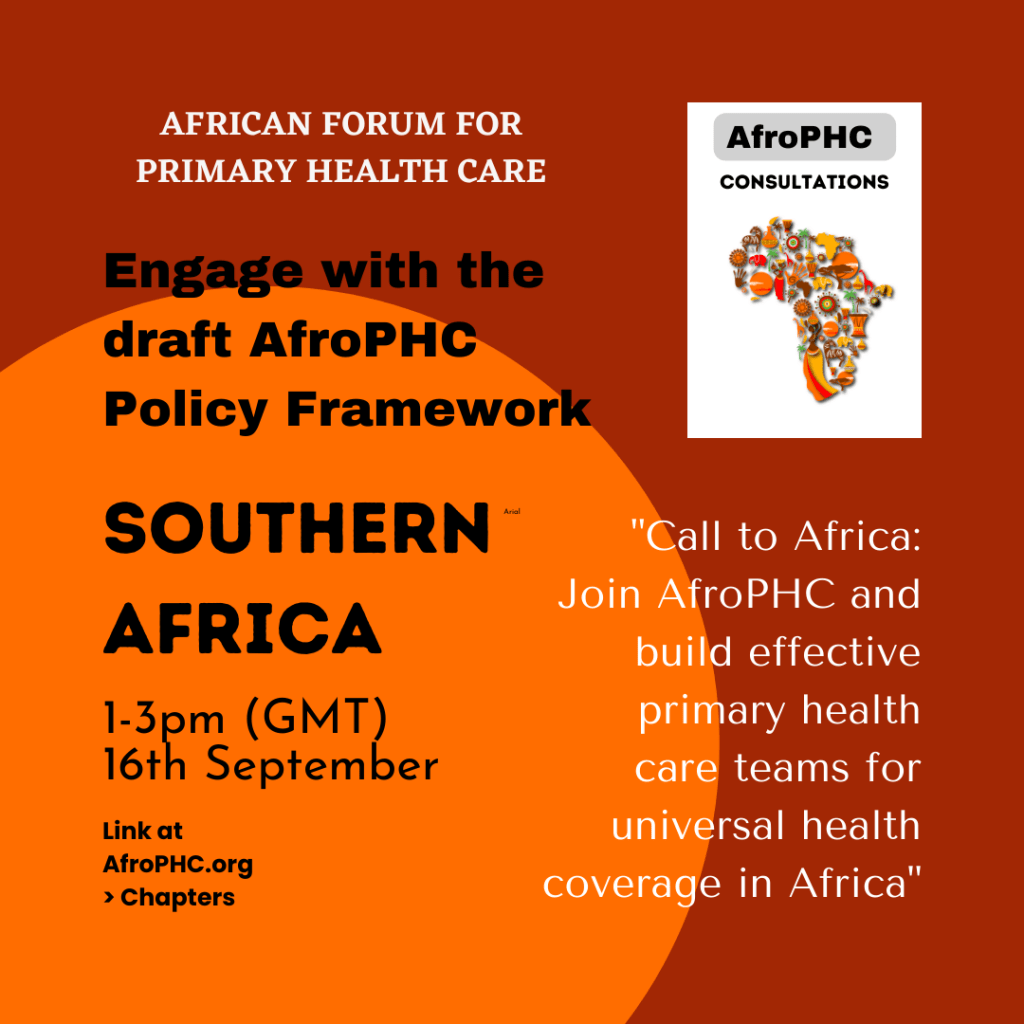
Join us 1-3pm GMT this Friday 16th September to meet with as many colleagues from South Africa, Zimbabwe, Namibia, Botswana, Lesotho, Eswatini [with English-French translators]. The consultation will be facilitated by Cynthia Chaibva and Jamie Colloty
The agenda is as follows. The link is below
Welcome/Introductions
Introduction to AfroPHC and Chapter Discussions on “What are the challenges of PHC in the region?”
Review of AfroPHC Policy Framework Discussions on “The Draft Policy Framework: what we like, don’t like and suggestions”
Join the AfroPHC Southern Africa WhatsApp group and engage in discussions before and after our consultations https://chat.whatsapp.com/GV7f8h3T4vpAMYixbMCMiC See more here [https://atomic-temporary-69625775.wpcomstaging.com/chapters/].
We are very keen that as many local stakeholders participate. These include professional associations, ministries of health, accreditation / certification bodies, academics, patient advocacy groups etc. Please feel free to share this email to any key stakeholders you think should be there and ask them to join us to discuss AfroPHC and the Policy Framework.
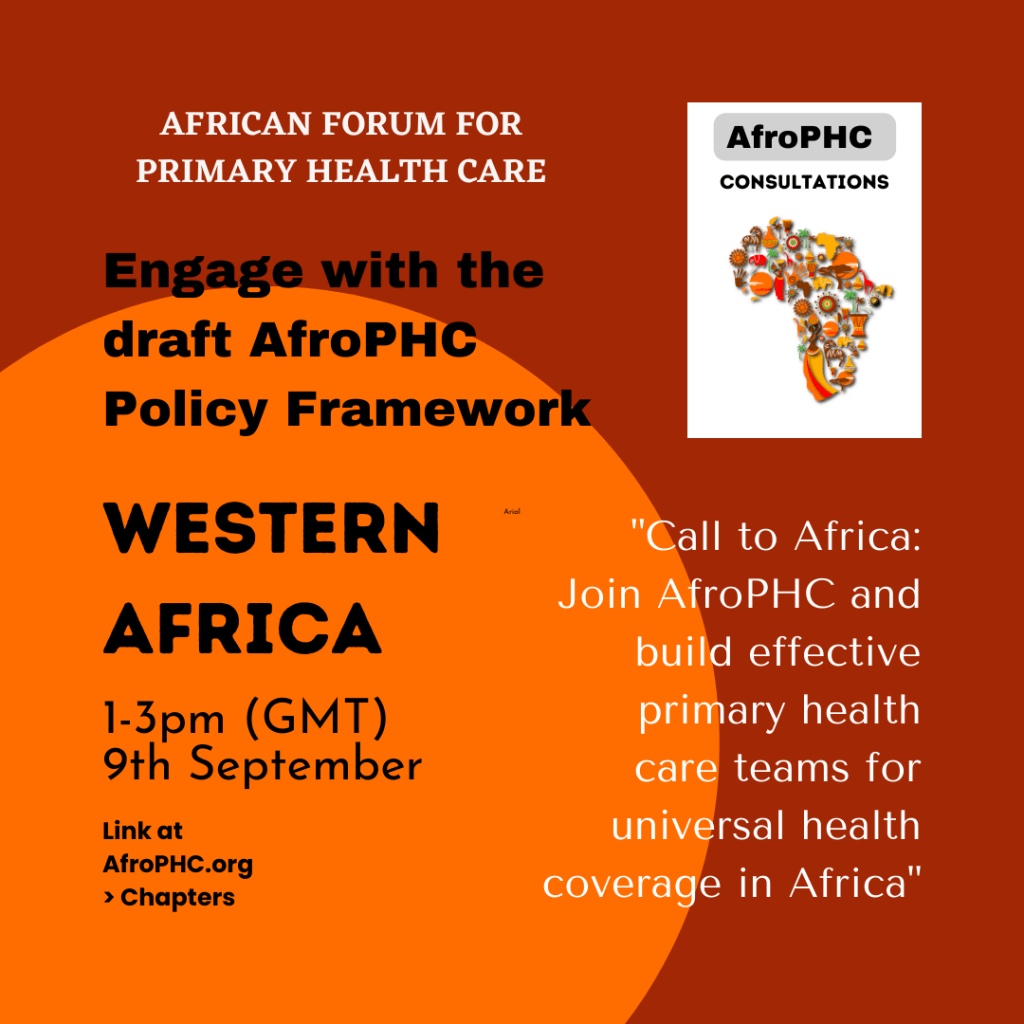
Join us 1-3pm GMT this Friday 9th September to meet with as many colleagues from Nigeria, Ghana, Niger, Guinea, Benin, Burundi, Togo, Sierra Leone, Liberia, Mauritania, Gambia, Cote d’Ivoire, Burkina Faso, Mali, Senegal [with English-French translators]. The consultation will be facilitated by Joseph Ana and Umar Ibrahim.
The agenda is as follows. The link is below
Welcome/Introductions
Introduction to AfroPHC and Chapter Discussions on “What are the challenges of PHC in the region?”
Review of AfroPHC Policy Framework Discussions on “The Draft Policy Framework: what we like, don’t like and suggestions”
Join the AfroPHC Western Africa WhatsApp group and engage in discussions before and after our consultations https://chat.whatsapp.com/DvJvzMzonXr7E0Zt7ED8Wa See more here [https://atomic-temporary-69625775.wpcomstaging.com/chapters/].
We are very keen that as many local stakeholders participate. These include professional associations, ministries of health, accreditation / certification bodies, academics, patient advocacy groups etc. Please feel free to share this email to any key stakeholders you think should be there and ask them to join us to discuss AfroPHC and the Policy Framework.
Rejoignez-nous ce vendredi pour consulter en Afrique de l’Ouest
Nous tenons vraiment à ce que le plus grand nombre de personnes s’engagent avec AfroPHC et le projet de cadre politique. Vous pouvez faire un commentaire ici.
Rejoignez-nous de 13h à 15h GMT ce vendredi 9 septembre pour rencontrer autant de collègues du Nigeria, du Ghana, du Niger, de la Guinée, du Bénin, du Burundi, du Togo, de la Sierra Leone, du Libéria, de la Mauritanie, de la Gambie, de la Côte d’Ivoire, du Burkina Faso, du Mali, Sénégal [avec traducteurs anglais-français]. La consultation sera animée par Joseph Ana et Umar Ibrahim.
L’ordre du jour est le suivant. Le lien est ci-dessous
• Bienvenue/Présentations
• Introduction à AfroPHC et discussions de chapitre sur « Quels sont les défis des SSP dans la région ? »
• Examen des discussions sur le cadre politique d’AfroPHC sur “Le projet de cadre politique : ce que nous aimons, n’aimons pas et suggestions”
• Discussions sur « Comment faire avancer AfroPHC ? »
Rejoignez le groupe WhatsApp AfroPHC Afrique de l’Ouest et engagez des discussions avant et après nos consultations https://chat.whatsapp.com/DvJvzMzonXr7E0Zt7ED8Wa Voir plus ici [https://atomic-temporary-69625775.wpcomstaging.com/chapters/].
Nous tenons à ce qu’un maximum d’acteurs locaux y participent. Il s’agit notamment d’associations professionnelles, de ministères de la santé, d’organismes d’accréditation/de certification, d’universitaires, de groupes de défense des patients, etc. N’hésitez pas à partager cet e-mail avec toutes les parties prenantes clés qui, selon vous, devraient être présentes et à leur demander de se joindre à nous pour discuter d’AfroPHC et du cadre politique.
The ICN NP/APN 2022 has just ended with evidence of remarkable progress in APN/APM Africa. Of significance, Associate Professor Eunice Ndirangu (Aga Khan East Africa Dean) and CEO/Registrar Edna Tallam-Kimaiyo (Nurses Council of Kenya) were awarded the two LIMC grants by the ICN NP/APNN (See attached photos – both with ICN CEO Howard Catton and ICN NP/APNN Chair Dr Daniela Lehwaldt
The two Kenyan nursing and midwifery leaders also presented on “Formative Research to inform Development of the Advanced Practice Nursing & Advanced Practice Midwifery Scopes of Practice in Kenya” & “Institutionalisation of APN & APM in Kenya” respectively during the conference.
Both Dr Ndirangu and CEO Tallam-Kimaiyo have consistently contributed towards APN Africa work including the Nairobi 2019 workshops and the APN Educational Leadership Symposium 2020 hosted by AfroPHC and ICN NP/APNN in collaboration with other key APN Stakeholders.
Collaborator(s) with access to major databases such as CINAL, EMBASE etc) are needed to do a review (any type) or secondary analysis on rural nursing or practice in Africa which will result in presenting at a rural health conference in Sydney next year.
Join us 10-1pm GMT this Saturday 3rd September to meet with as many colleagues from our Youth Hub Leaders https://atomic-temporary-69625775.wpcomstaging.com/afrophc-youth-hub/ [with English-French translators]. The consultation will be facilitated by Mercy Wanjala and Jamie Colloty.
The agenda is as follows. The link is below
Welcome/Introductions
Introduction to AfroPHC and Chapter Discussions on “What are the challenges of PHC in the region?”
Review of AfroPHC Policy Framework Discussions on “The Draft Policy Framework: what we like, don’t like and suggestions”
Join the AfroPHC WhatsApp groups and engage in discussions before and after our consultations https://chat.whatsapp.com/GV7f8h3T4vpAMYixbMCMiC See more here [https://atomic-temporary-69625775.wpcomstaging.com/chapters/].
We are very keen that as many local stakeholders participate. These include professional associations, ministries of health, accreditation / certification bodies, academics, patient advocacy groups etc. Please feel free to share this email to any key stakeholders you think should be there and ask them to join us to discuss AfroPHC and the Policy Framework.
Nous tenons vraiment à ce que le plus grand nombre de personnes s’engagent avec AfroPHC et le projet de cadre politique. Vous pouvez faire un commentaire ici.
Rejoignez-nous de 10h à 13h GMT ce samedi 3 septembre pour rencontrer autant de collègues de nos leaders du Youth Hub https://atomic-temporary-69625775.wpcomstaging.com/afrophc-youth-hub/ [avec des traducteurs anglais-français]. La consultation sera animée par Mercy Wanjala et Jamie Colloty.
L’ordre du jour est le suivant. Le lien est ci-dessous
• Bienvenue/Présentations
• Introduction à AfroPHC et discussions de chapitre sur « Quels sont les défis des SSP dans la région ? »
• Examen des discussions sur le cadre politique d’AfroPHC sur “Le projet de cadre politique : ce que nous aimons, n’aimons pas et suggestions”
• Discussions sur « Comment faire avancer AfroPHC ? »
Rejoignez les groupes AfroPHC WhatsApp et engagez des discussions avant et après nos consultations https://chat.whatsapp.com/GV7f8h3T4vpAMYixbMCMiC Voir plus ici [https://atomic-temporary-69625775.wpcomstaging.com/chapters/].
Nous tenons à ce qu’un maximum d’acteurs locaux y participent. Il s’agit notamment d’associations professionnelles, de ministères de la santé, d’organismes d’accréditation/de certification, d’universitaires, de groupes de défense des patients, etc. N’hésitez pas à partager cet e-mail avec toutes les parties prenantes clés qui, selon vous, devraient être présentes et à leur demander de se joindre à nous pour discuter d’AfroPHC et du cadre politique. .
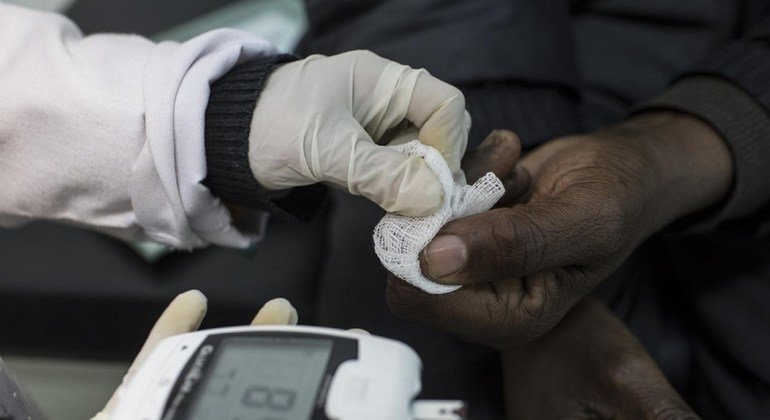
With the burden of cardiovascular disease, mental and neurological disorders and diabetes rising in the region, African health ministers on Tuesday, endorsed a new strategy to boost access to the diagnosis, treatment and care of severe noncommunicable diseases.
The health ministers, gathering for the seventy-second session of the UN World Health Organization (WHO) Regional Committee for Africa in Lomé, Togo, adopted the strategy, known as PEN-PLUS. That plan will be implemented as a regional strategy to address severe noncommunicable diseases at first-level referral health facilities. The strategy supports building the capacity of district hospitals and other first-level referral facilities to diagnose and manage severe noncommunicable diseases…more
Join Sigma and your peers in nursing research and evidence-based practice in Abu Dhabi, United Arab Emirates, for the 34th International Nursing Research Congress, taking place 20-24 July 2023 at the Abu Dhabi National Exhibition Centre.
The 2023 congress theme is Connect Nursing Globally Through Research and Evidence Dissemination.
Call for Abstracts Opportunities are now available to submit research- and evidence-based practice abstracts. Submission Deadline: 2 November 2022

















 AfroPHC