Female Health Workers at the Doorstep: A Pilot of Community-Based Maternal, Newborn, and Child Health Service Delivery in Northern Nigeria

Charles A Uzondu, Henry V Doctor, Sally E Findley, Godwin Y Afenyadu, and Alastair Ager.

Glob Health Sci Pract. 2015 Mar; 3(1): 97–108.

https://www.ncbi.nlm.nih.gov/pmc/articles/PMC4356278/

ABSTRACT

Introduction: Nigeria has one of the highest maternal mortality ratios in the world. Poor health outcomes are linked to weak health infrastructure, barriers to service access, and consequent low rates of service utilization. In the northern state of Jigawa, a pilot study was conducted to explore the feasibility of deploying resident female Community Health Extension Workers (CHEWs) to rural areas to provide essential maternal, newborn, and child health services.

Methods: Between February and August 2011, a quasi-experimental design compared service utilization in the pilot community of Kadawawa, which deployed female resident CHEWs to provide health post services, 24/7 emergency access, and home visits, with the control community of Kafin Baka. In addition, we analyzed data from the preceding year in Kadawawa, and also compared service utilization data in Kadawawa from 2008–2010 (before introduction of the pilot) with data from 2011–2013 (during and after the pilot) to gauge sustainability of the model.

Results: Following deployment of female CHEWs to Kadawawa in 2011, there was more than a 500% increase in rates of health post visits compared with 2010, from about 1.5 monthly visits per 100 population to about 8 monthly visits per 100. Health post visit rates were between 1.4 and 5.5 times higher in the intervention community than in the control community. Monthly antenatal care coverage in Kadawawa during the pilot period ranged from 11.9% to 21.3%, up from 0.9% to 5.8% in the preceding year. Coverage in Kafin Baka ranged from 0% to 3%. Facility-based deliveries by a skilled birth attendant more than doubled in Kadawawa compared with the preceding year (105 vs. 43 deliveries total, respectively). There was evidence of sustainability of these changes over the 2 subsequent years.

Conclusion: Community-based service delivery through a resident female community health worker can increase health service utilization in rural, hard-to-reach areas.

Trump to pull out of the UN and WHO?

Those who care about the future of the UN and its specialized agencies (including WHO) should be concerned about a bill introduced quietly to the US Congress in early January that calls for the United States to pull out of the United Nations and WHO.

The bill, H.R. 193 — known as the American Sovereignty Restoration Act — is on the US Congress website (https://www.congress.gov/bill/115th-congress/house-bill/193).

It was introduced to the House on January 3 and referred to the Committee on Foreign Affairs. The official summary of the bill is as follows:

“This bill repeals the United Nations Participation Act of 1945 and other specified related laws. The bill requires: (1) the President to terminate U.S. membership in the United Nations (U.N.), including any organ, specialized agency, commission, or other formally affiliated body; and (2) closure of the U.S. Mission to the United Nations. The bill

prohibits: (1) the authorization of funds for the U.S. assessed or voluntary contribution to the U.N., (2) the authorization of funds for any U.S. contribution to any U.N. military or peacekeeping operation, (3) the expenditure of funds to support the participation of U.S. Armed Forces as part of any U.N. military or peacekeeping operation, (4) U.S.

Armed Forces from serving under U.N. command, and (5) diplomatic immunity for U.N. officers or employees.”

According an Inter-Press Service News Agency article by Baher Kamal entitled “Trump to Pull Out of the UN, Expel It from the US?” (http://www.ipsnews.net/2017/01/trump-to-pull-out-of-the-un-expel-it-from-the-us/), “While its official title says it seeks to end membership in the U.N., there are several other key components of the bill which include: ending the 1947 agreement that the U.N. headquarters will be housed in the U.S., ending peacekeeping operations, removing diplomatic immunity, and ending participation in the World Health Organization. Should the bill pass, the Act and its amendments will go into effect two years after it has been signed.”

Chris Zielinski

chris@chriszielinski.com

Blogs: http://ziggytheblue.wordpress.com and

http://ziggytheblue.tumblr.com

Research publications: http://www.researchgate.net

HIFA profile: Chris Zielinski: As a Visiting Fellow in the Centre for Global Health, Chris leads the Partnerships in Health Information (Phi) programme at the University of Winchester.

TOP 10 TIPS FOR REDUCING SALT IN YOUR DIET

When it comes to dietary sodium, less is certainly best, yet Americans today consume 50% more than the recommended daily quantities of sodium. Diets high in sodium increase blood pressure levels. High blood pressure damages the kidneys over time, and is a leading cause of kidney failure. To help Americans reduce salt intake to the ideal one teaspoon per day, the National Kidney Foundation offers 10 tips to reduce sodium in your diet. To help Americans reduce salt intake to the ideal one teaspoon per day, the National Kidney Foundation and Council of Renal Nutrition member Linda Ulrich offer 10 tips to reduce sodium in your diet….more

Colic Relief Tips for Parents

Does your infant have a regular fussy period each day when it seems you can do nothing to comfort her? This is quite common, particularly between 6:00 p.m. and midnight—just when you, too, are feeling tired from the day’s trials and tribulations. These periods of crankiness may feel like torture, especially if you have other demanding children or work to do, but fortunately they don’t last long. The length of this fussing usually peaks at about three hours a day by six weeks and then declines to one or two hours a day by three to four months. As long as the baby calms within a few hours and is relatively peaceful the rest of the day, there’s no reason for alarm….more

Repealing the ACA without a Replacement — The Risks to American Health Care

Barack H. Obama, J.D.

N Engl J Med 2017; 376:297-299January 26, 2017DOI: 10.1056/NEJMp1616577

Health care policy often shifts when the country’s leadership changes. That was true when I took office, and it will likely be true with President-elect Donald Trump. I am proud that my administration’s work, through the Affordable Care Act (ACA) and other policies, helped millions more Americans know the security of health care in a system that is more effective and efficient. At the same time, there is more work to do to ensure that all Americans have access to high-quality, affordable health care. What the past 8 years have taught us is that health care reform requires an evidence-based, careful approach, driven by what is best for the American people. That is why Republicans’ plan to repeal the ACA with no plan to replace and improve it is so reckless. Rather than jeopardize financial security and access to care for tens of millions of Americans, policymakers should develop a plan to build on what works before they unravel what is in place.

Thanks to the ACA, a larger share of Americans have health insurance than ever before.1 Increased coverage is translating into improved access to medical care — as well as greater financial security and better health. Meanwhile, the vast majority of Americans still get their health care through sources that predate the law, such as a job or Medicare, and are benefiting from improved consumer protections, such as free preventive services…..more

What is Diabetes?

Diabetes is a disease that occurs when your blood glucose, also called blood sugar, is too high. Blood glucose is your main source of energy and comes from the food you eat. Insulin, a hormone made by the pancreas, helps glucose from food get into your cells to be used for energy. Sometimes your body doesn’t make enough—or any—insulin or doesn’t use insulin well. Glucose then stays in your blood and doesn’t reach your cells.

Over time, having too much glucose in your blood can cause health problems. Although diabetes has no cure, you can take steps to manage your diabetes and stay healthy.

Sometimes people call diabetes “a touch of sugar” or “borderline diabetes.” These terms suggest that someone doesn’t really have diabetes or has a less serious case, but every case of diabetes is serious…..more

Insights of health district managers on the implementation of primary health care outreach teams in Johannesburg, South Africa: a descriptive study with focus group discussions

Abstract

Background: Primary health care (PHC) outreach teams are part of a policy of PHC re-engineering in South Africa. It attempts to move the deployment of community health workers (CHWs) from vertical programmes into an integrated generalised team-based approach to care for defined populations in municipal wards. There has little evaluation of PHC outreach teams. Managers’ insights are anecdotal.

Methods: This is descriptive qualitative study with focus group discussions with health district managers of Johannesburg, the largest city in South Africa. This was conducted in a sequence of three meetings with questions around implementation, human resources, and integrated PHC teamwork. There was a thematic content analysis of validated transcripts using the framework method.

Results: There were two major themes: leadership-management challenges and human resource challenges. Whilst there was some positive sentiment, leadership-management challenges loomed large: poor leadership and planning with an under-resourced centralised approach, poor communications both within the service and with community, concerns with its impact on current services and resistance to change, and poor integration, both with other streams of PHC re-engineering and current district programmes. Discussion by managers on human resources was mostly on the plight of CHWs and calls for formalisation of CHWs functioning and training and nurse challenges with inappropriate planning and deployment of the team structure, with brief mention of the extended team.

Conclusions: Whilst there is positive sentiment towards intent of the PHC outreach team, programme managers in Johannesburg were critical of management of the programme in their health district. Whilst the objective of PHC reform is people-centred health care, its implementation struggles with a centralising tendency amongst managers in the health service in South Africa. Managers in Johannesburg advocated for decentralisation. The implementation of PHC outreach teams is also limited by difficulties with formalisation and training of CHWs and appropriate task shifting to nurses. Change management is required to create true integrate PHC teamwork. Policy review requires addressing these issues.

Keywords: Primary health care, Community healthcare workers, Outreach teams, Africa, Human resources, Policy

Insights of health district managers on the implementation of primary health care outreach teams in Johannesburg, South Africa: a descriptive study with focus group …

S Moosa, A Derese, W Peersman – Human Resources for Health, 2017

Coke faces deception case

Are you drinking yourself sick?Buying scientists. Misleading the public. Coca Cola USA is facing a lawsuit for manipulating the public. Meanwhile in South Africa, fizzy drink manufacturers are using all kinds of tactics to stop the proposed tax on sugary drinks.  Are you drinking yourself sick? Four days into 2017, Coca Cola USA was slapped with a lawsuit aimed at stopping its “campaign of deception” to downplay the health risks of its drinks. The non-profit organisation, Praxis Project, wants to stop Coca Cola and the American Beverage Association (ABA) from “deceiving the public on the science linking obesity and related diseases to regular consumption of sugar-sweetened beverages” and to stop them from marketing their drinks to children…..more

ADVANCE HIV study set to save SA billions

aidsribbonsA new HIV drug combination could save SA billions of rands – plus it would be easier and safer for patients to take. Launched on Monday, the ADVANCE study will evaluate a HIV treatment regimen including two newer and cheaper drugs: dolutegravir (DTG) and tenofovir alafenamide (TAF). “If successful, patients will benefit from a much safer and more forgiving drug regimen in a smaller tablet,” said Francois Venter, Deputy Director of the Wits Reproductive Health and HIV Institute (WRHI)……more

Management of patient information Trends and challenges in Member States

Executive summary

Information and communication technologies (ICTs) have great potential to improve health in both developed and developing countries by enhancing access to health information and making health services more efficient; they can also contribute to improving the quality of services and reducing their cost. Patient information systems, for example, have the ability to track individual health problems and treatment over time, giving insight into optimal diagnosis and treatment of the individual as well as improving the delivery of services. This is particularly useful for chronic diseases, such as diabetes and cardiovascular diseases, and for maternal and child health services where a record of health and treatment over a period of time is required. Analysis of data in patient information systems can lead to new insight and understanding of health and disease, both chronic and acute.

Over the past decades, there have been great advances in ICTs for health, and the World Health Organization (WHO) has responded by establishing the Global Observatory for eHealth (GOe) to assess the adoption of eHealth in Member States as well as the benefits that ICTs can bring to health care and patients’ well-being. To that end, the second global survey on eHealth was launched in late 2009, designed to explore eight eHealth areas in detail.

This, the final report in the Global Observatory for eHealth Series, assesses the results of the survey module that dealt with the patient information. It examines the adoption and use of patient information systems in Member States and reviews data standards and legal protection for patient data. The survey results – provided by WHO region, World Bank income group, and globally – showed that electronic information systems are being increasingly adopted within health settings; while this is seen primarily in higher-income countries, emerging economies such as Brazil, China and India, for instance, are also beginning to introduce electronic medical records (EMRs) into their health systems.

Low-income countries, however, have struggled to initiate large-scale electronic medical record systems. While some low-income countries have been able to attract technical and financial resources to install patient information systems at some sites, these require significant investments for their successful implementation. In fact, these systems require abundant resources including skilled labour, technological, and financial means, all of which can be difficult to procure in low-income settings. Further, patient information systems designed for high-income country health systems may not be appropriate in low-income countries In particular, internationally-harmonized clinical models and concepts are needed for data interoperability and standardized international case-reporting, which could mitigate discrepancies between systems. The International Organization for Standardization’s Technical Committee on health informatics ISO TC 215, or example, has developed an eHealth architecture that incorporates levels of maturity into the components of a health system to address these differences in requirements and capacity.

Of course, these issues are only relevant to electronic patient information systems. While use of such systems is increasing, many Member States still rely on paper-based systems for health data collection. The survey data analysed by WHO region showed that all regions have a high use of paper-based systems, particularly the African Region and South-East Asia Region. Countries within the Regions of the Americas, Eastern Mediterranean, and the Western Pacific reported a higher use of electronic transmission of health records than computer use to collect health data. This may be due to the use of fax or scanned image technology where the communication is electronic but the origin and destination are paper.

The use of electronic systems is higher for aggregated (summary) data than individual patient data. This could be because there is an institutional need for the aggregate data at management levels which in turn stimulates the creation of an electronic system. There may be a perception that individual patient data in electronic format may not be of as much value for administration, particularly given the difficulty of implementing patient information systems in general. However, the value of individual patient data for improved patient care is very much a case of ‘connect the dots’: given that many patients receive services from separate facilities and care providers, some form of electronic record system could compile these data and make them accessible to other health care professionals, leading, for example, to early detection of an influenza outbreak.

Electronic health systems must be built in a way to facilitate the exchange of data; disparate systems using separate disease definitions, for example, are of little value. Standards must be applied to the data and the systems themselves to allow for and facilitate the exchange of data between various sources. The adoption of standards is progressing well across most Member States including standards for eHealth architecture, data, interoperability, vocabulary, and messaging. These are important foundation blocks for the implementation of patient information systems because they facilitate clear communication. In addition, most countries have taken steps to establish legal frameworks for the protection of patient data.

The report concludes with an overview of steps Member States can take to facilitate the implementation of patient information systems. These include adoption of open source, standards-based software platforms and data exchange standards to make efficient use of existing resources. In addition, there needs to be clear legislation governing patient privacy and protecting the security of health information for records in electronic format. Finally, the development of well-trained health informatics professionals should be a priority.

More

Sustainability of performance based incentivized community health worker’s model in high priority districts of Odisha, India

Abstract: Mixed method approach was used to explore the sustainability of Accredited Social Health Activists (ASHAs) model in high priority districts of Odisha, India. A survey was conducted among 134 ASHAs followed by qualitative study among anganwadi workers auxiliary nurse midwives and non-governmental field coordinators. A conceptual framework was developed using grounded theory approach. The sustainability of ASHA model depended on the balance relationship between motivating and demotivating factors – the model may collapse if demotivating factors will be more than the motivating factors. In order to sustain the program, the demotivating factors should be minimized through eight mechanisms – incentive, insurance, free transport, recognition, role definition, training, hand holding support and supplies of logistics for sustainability of the ASHAs model. This study recommends the further research on policy or decision makers and program implementer’s prospective towards ASHA model in India.

The full text is freely available here: http://www.worldwidejournals.in/ojs/index.php/ijsr/article/view/13988/14107 

Who is a CHW? Liberators or Lackeys?

Community Health Workers: Liberators or Lackeys?  [1]

David Werner had raised this question in 1981, and today 16 years later, it is still valid. Community Health Workers can be paid workers or volunteers [2], and both situations have implications for strategies of supporting them, and articulating expectations from them. Under the leadership of Jack Bryant [3], Community Health Sciences Dept of Aga Khan University, two models of CHW were tested. One was called ‘CHS led’ model in which an honorarium was paid to the CHWs, and the other was Community led model where health volunteers worked with the PHC team. The striking feature of the latter was manifest in a question a health volunteer asked the community health nurse, ‘why are you late today?’. The paid CHW, would never have the courage to ask such a question, and their subordination was embodied in their remark when at a meeting in the PHC center, they refused to sit on the chair of the field director of the PHC program. ‘we can’t sit on that chair’, said one when she was being goaded to take the chair, looking at the large black, high back chair, leaning back,  behind a desk. What is the source of power of a CHW, one could ask. What ‘power’ does a CHW have when she is subordinate to the PHC team, and undertake tasks determined by the PHC Team, compared to a CHW who derives her strength from the community to which she is accountable.

The trend in approach to CHW is more to seek improvement in her performance, and for fulfilling the task assigned to her. A systematic review of published articles on CHWs was said to provide following key messages:

1. A systematic review of 140 quantitative and qualitative studies identified factors related to the nature of tasks and time spent on delivery, human resource management, quality assurance, links with the community, links with the health system and resources and logistics having an influence on CHW performance.

2. Good performance was associated with intervention designs involving a mix of incentives, frequent supervision, continuous training, community involvement and strong co-ordination and communication between CHWs and health professionals, leading to increased credibility of CHWs.

3. When designing CHW programmes, policymakers should take into account factors that increased CHW performance in comparable settings, to maximize programme outcomes. [4]

As is quite apparent from the above points, CHWs is seen as  a means for achieving some objectives, which are supposed to ensure health of the population being served. This is what makes them ‘lackeys’ (doing what has been assigned by somebody else), and not liberators, as Paolo Freire outlines liberation and liberators.

The notion of ‘liberator’ that is invoked in David Werner’s article is well explained in Paolo Freire’s thoughts and practices.

This person is not afraid to meet the people or to enter into a dialogue with them. This person does not consider himself or herself the proprietor of history or of all people, or the liberator of the oppressed; but he or she does commit himself or herself, within history, to fight at their side.”  Paulo Freire, Pedagogy of the Oppressed

“Liberating education consists in acts of cognition, not transferals of information.”  [5]

For a CHW to be a liberator  means she is a critical thinker who recognized the structures of oppression which lead to poor health outcomes. In other words she would understand the importance of social determinants of health (SDH).  She would be trained to reflect, analyze and facilitate the community to do the same, so that they could explore options for actions. In other words, the pedagogy used for CHWs would be critical. It would not only be based on scientific knowledge, but also on Freirean principles of education. (Education as liberation and not domestication.)

CONCLUSION

… the point is that if poor health is a political problem it will need a political not a technical solution. The answer is not more health care workers. The answer is health care workers who I. – can mobilize their own communities to improve their own health. Susan Rifkin [6]

There are many developing countries where the State commitment to the health of the poor is grossly inadequate. (Example Pakistan). Where there is no state, then other actors are needed – both professionals, and the community (the oppressed groups specially). How CHWs become liberators means they can mobilize/engage/involve communities to address social determinants of health, and also  hold the state accountable

Role of CHWs as leaders and not mere agents of health managers is the goal to promote and support.

1. David Werner had raised this issue in his article The Village Health Worker,  Lackay or Liberator.  1981(http://www.fastonline.org/CD3WD_40/JF/JF_VE/SMALL/27-714.pdf)

2. CHWs are volunteers in Kenya and Iran, to name some countries . In Kenya, when I had an opportunity to meet some CHWs I was struck by the role of a church in creating economic  opportunities for them.

3. Jack Bryant had led the US delegation to the Alma Ata meeting in 1978. He was a friend of Hafden Mahler and was instrumental in getting Mahler spend a week in the department of Community Health Sciences (CHS) of Aga Khan University (AKU), Karachi. He was committed to PHC which was integrated in the undergraduate medical education of AKU.

4. Shared in list serve of HIFA (health information for all)  (HIFA@dgroups.org; on behalf of; Neil Pakenham-Walsh neil.pakenham-walsh@ghi-net.org. Jan 17, 2017)

5. Paulo Freire (https://www.goodreads.com/author/quotes/41108.Paulo_Freire)

6. Quoted in HEALTH PROMOTERS, POLITICAL STRUGGLE AND SOCIAL TRANSFORMATION , A Framework for Systematizing the Experience of a Popular Health Education Project in Chile A Master’s Project Completed by Karen L. Anderson

HIFA profile: Kausar Skhan is with the Community Health Sciences Dept of Aga Khan University, Karachi, Pakistan. kausar.skhan AT aku.edu
Effect of a Primary Care–Based Psychological Intervention on Symptoms of Common Mental Disorders in Zimbabwe A Randomized Clinical Trial

Key Points

Question  Does a lay health worker–delivered psychological intervention improve symptoms of depression and anxiety in Zimbabwe?

Findings  In a cluster randomized clinical trial of 573 randomized patients with common mental disorders and symptoms of depression, the group who received the intervention had significantly lower symptom scores after 6 months compared with a control group who received enhanced usual care.

Meaning  The use of lay health workers in resource-poor countries like Zimbabwe may be effective primary care–based management of common mental disorders.

Abstract

Importance  Depression and anxiety are common mental disorders globally but are rarely recognized or treated in low-income settings. Task-shifting of mental health care to lay health workers (LHWs) might decrease the treatment gap.

Objective  To evaluate the effectiveness of a culturally adapted psychological intervention for common mental disorders delivered by LHWs in primary care.

Design, Setting, and Participants  Cluster randomized clinical trial with 6 months’ follow-up conducted from September 1, 2014, to May 25, 2015, in Harare, Zimbabwe. Twenty-four clinics were randomized 1:1 to the intervention or enhanced usual care (control). Participants were clinic attenders 18 years or older who screened positive for common mental disorders on the locally validated Shona Symptom Questionnaire (SSQ-14).

Interventions  The Friendship Bench intervention comprised 6 sessions of individual problem-solving therapy delivered by trained, supervised LHWs plus an optional 6-session peer support program. The control group received standard care plus information, education, and support on common mental disorders.

Main Outcomes and Measures  Primary outcome was common mental disorder measured at 6 months as a continuous variable via the SSQ-14 score, with a range of 0 (best) to 14 and a cutpoint of 9. The secondary outcome was depression symptoms measured as a binary variable via the 9-item Patient Health Questionnaire, with a range of 0 (best) to 27 and a cutpoint of 11. Outcomes were analyzed by modified intention-to-treat.

Results  Among 573 randomized patients (286 in the intervention group and 287 in the control group), 495 (86.4%) were women, median age was 33 years (interquartile range, 27-41 years), 238 (41.7%) were human immunodeficiency virus positive, and 521 (90.9%) completed follow-up at 6 months. Intervention group participants had fewer symptoms than control group participants on the SSQ-14 (3.81; 95% CI, 3.28 to 4.34 vs 8.90; 95% CI, 8.33 to 9.47; adjusted mean difference, −4.86; 95% CI, −5.63 to −4.10; P < .001; adjusted risk ratio [ARR], 0.21; 95% CI, 0.15 to 0.29; P < .001). Intervention group participants also had lower risk of symptoms of depression (13.7% vs 49.9%; ARR, 0.28; 95% CI, 0.22 to 0.34; P < .001).

Conclusions and Relevance  Among individuals screening positive for common mental disorders in Zimbabwe, LHW-administered, primary care–based problem-solving therapy with education and support compared with standard care plus education and support resulted in improved symptoms at 6 months. Scaled-up primary care integration of this intervention should be evaluated.

CITATION: Effect of a Primary Care–Based Psychological Intervention on Symptoms of Common Mental Disorders in Zimbabwe.

A Randomized Clinical Trial.

Dixon Chibanda, Helen A. Weiss, Ruth Verhey, Victoria Simms, Ronald Munjoma, Simbarashe Rusakaniko, Alfred Chingono, Epiphania Munetsi, Tarisai Bere, Ethel Manda, Melanie Abas, Ricardo Araya.

JAMA. 2016;316(24):2618-2626. doi:10.1001/jama.2016.19102

The abstract is available here:

http://jamanetwork.com/journals/jama/article-abstract/2594719

Which intervention design factors influence performance of community health workers in low- and middle-income countries? A systematic review

CITATION: Which intervention design factors influence performance of community health workers in low- and middle-income countries? A systematic review

Maryse C Kok, Marjolein Dieleman, Miriam Taegtmeyer, Jacqueline EW Broerse, Sumit S Kane, Hermen Ormel, Mandy M Tijm1 and Korrie AM de Koning

Health Policy and Planning 2015;30:1207­1227 doi:10.1093//heapol/czu126

http://heapol.oxfordjournals.org/content/early/2014/12/11/heapol.czu126  (open access)

Abstract

Community health workers (CHWs) are increasingly recognized as an integral component of the health workforce needed to achieve public health goals in low- and middle-income countries (LMICs). Many factors influence CHW performance. A systematic review was conducted to identify intervention design related factors influencing performance of CHWs. We systematically searched six databases for quantitative and qualitative studies that included CHWs working in promotional, preventive or curative primary health services in LMICs. One hundred and forty studies met the inclusion criteria, were quality assessed and double read to extract data relevant to the design of CHW programmes. A preliminary framework containing factors influencing CHW performance and characteristics of CHW performance (such as motivation and competencies) guided the literature search and review.

A mix of financial and non-financial incentives, predictable for the CHWs, was found to be an effective strategy to enhance performance, especially of those CHWs with multiple tasks. Performance-based financial incentives sometimes resulted in neglect of unpaid tasks. Intervention designs which involved frequent supervision and continuous training led to better CHW performance in certain settings. Supervision and training were often mentioned as facilitating factors, but few studies tested which approach worked best or how these were best implemented. Embedment of CHWs in community and health systems was found to diminish workload and increase CHW credibility. Clearly defined CHW roles and introduction of clear processes for communication among different levels of the health system could strengthen CHW performance.

When designing community-based health programmes, factors that increased CHW performance in comparable settings should be taken into account. Additional intervention research to develop a better evidence base for the most effective training and supervision mechanisms and qualitative research to inform policymakers in development of CHW interventions are needed.

High Intensity Interval Training (HIIT): Best Cardio to Burn Fat

When most people think of cardio, they think of long, boring jogs, or endless hours on the elliptical. I’ve got good news for you: there’s a method of cardio that takes much less time and is far superior to jogging to help you burn fat. It’s called High Intensity Interval Training (HIIT) and this article will give you the basics so you can take your body to a new fitness level….more

App on Safe Pregnancy

Hesperian’s comprehensive app on pregnancy and birth contains a wealth of information on:

  • how to stay healthy during pregnancy
  • how to recognize danger signs during pregnancy, birth, and
    after birth
  • what to do when a danger sign arises
  • when to refer a woman to emergency care
  • instructions for community health workers with step-by-step explanations such as “How to take blood pressure,” “How to treat someone in shock,” “How to stop bleeding.”

See here

Free Clinical Guide Apps from SA

Screen Shot 2017-01-09 at 4.44.16 PM.png

Get the three Clinical Guides from South Africa free on IoS and Android.

  • TB
  • HIV
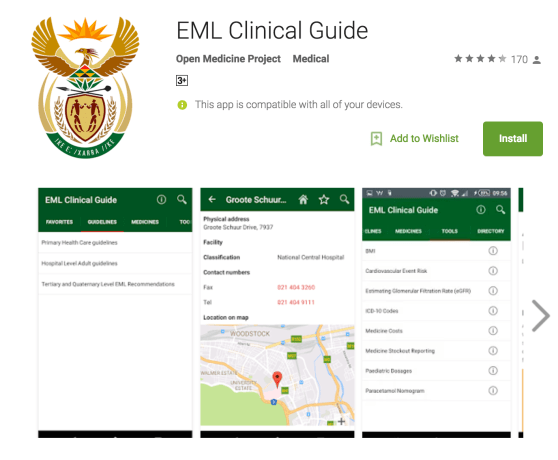
  • PHC EML- Essential Medicines List and Standard Treatment Guidelines

Just search for “Clin Guide” or “Clinical Guide”